Why Reliance Power Is Falling: Reliance Power Crashes to 52 Week Low
Why Reliance Power Is Falling: Reliance Power Crashes to 52 Week Low | Image Via Economics Times
Reliance Power shares are under pressure again as the stock continues to slide toward fresh lows. The fall has drawn attention across the market because the stock was once a popular retail pick during earlier rallies. Recent trading sessions show continued weakness, with investors struggling to find reasons to hold or add positions at current levels.
The decline is not linked to a single trigger. Instead, it reflects a mix of weak fundamentals, regulatory overhang, group level concerns, and changing market behaviour. As of mid January 2026, sentiment around the stock remains cautious, with most discussions focused on risk rather than recovery.
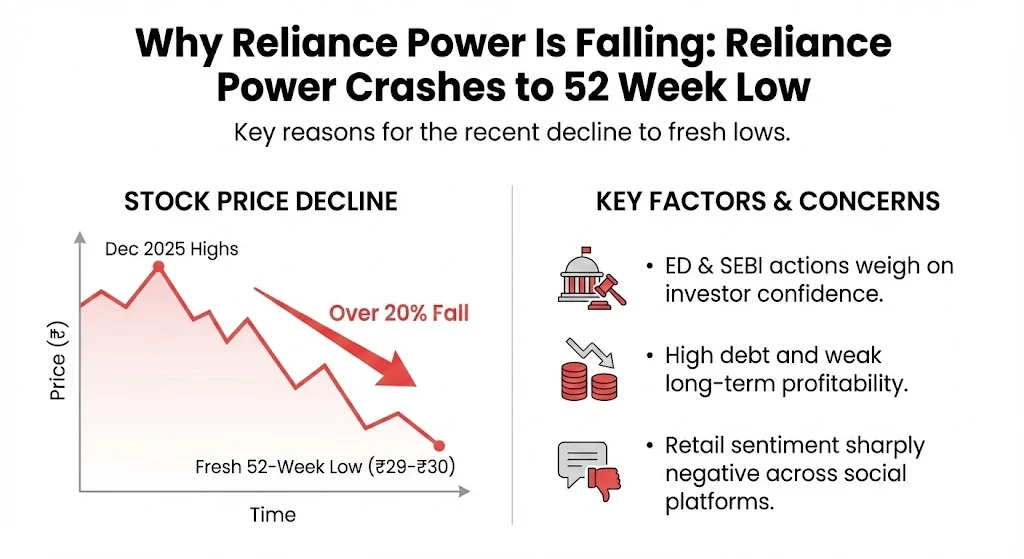
Table of Contents
Key Takeaways
- Reliance Power has slipped to fresh 52 week lows near ₹29 to ₹30
- The stock has fallen over 20 percent from December 2025 highs
- ED and SEBI actions continue to weigh on investor confidence
- High debt and weak long term profitability remain major concerns
- Retail sentiment has turned sharply negative across social platforms
Reliance Power Recent Stock Performance & Trend
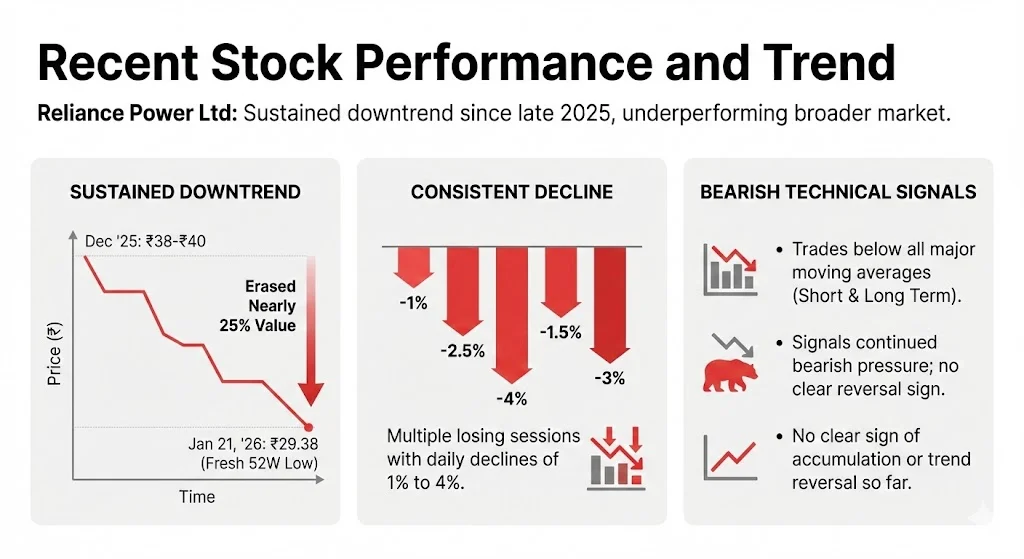
Reliance Power Ltd has remained in a sustained downtrend since late 2025. After trading near ₹38 to ₹40 levels in December, the stock lost momentum and slipped steadily through January. On January 21, 2026, it touched a fresh 52 week low around ₹29.38.
The fall has not been abrupt but consistent. The stock has recorded multiple losing sessions, with daily declines ranging between 1 percent and 4 percent. Over a short span of weeks, it erased nearly one fourth of its value, clearly underperforming both the broader market and the power sector.
Technically, the stock trades below all major moving averages. This includes short term and long term averages, which signals continued bearish pressure. There has been no clear sign of accumulation or trend reversal so far.
Also Read: Smart Digital Group Limited Stock Crash Raises Fresh Concerns Over Micro Cap Risks
Underperformance Against Market Benchmarks
Over the last one year, Reliance Power has delivered negative returns of over 25 percent. In contrast, the broader market has remained relatively stable. The benchmark index Sensex has posted positive returns over the same period, highlighting the stock specific nature of the fall.
The gap becomes more visible when compared to broader indices like BSE500, which have also managed modest gains. This underperformance suggests that investors are selectively exiting weaker balance sheet companies rather than reacting to a broad market correction.
Regulatory and Legal Overhang
One of the biggest reasons behind the fall is continued regulatory scrutiny. Ongoing Enforcement Directorate probes related to alleged fake bank guarantees linked to government tenders have kept sentiment weak. These cases, some connected to SECI related projects, have resurfaced in public discussions during late 2025 and early 2026.
In addition, forensic audits initiated by SEBI in January 2026 have added fresh uncertainty. These audits are reportedly examining possible violations under securities laws and the Companies Act. While outcomes are still awaited, the presence of multiple investigations creates a risk premium that the market is unwilling to ignore.
Such regulatory overhang tends to cap upside even during broader market recoveries, especially for companies already facing financial stress.
Financial Health and Debt Concerns
Reliance Power has long struggled with balance sheet issues. High leverage remains a key challenge, with debt levels far exceeding operating cash flows. The company’s debt to EBITDA ratio remains elevated, indicating pressure on debt servicing capacity.
Profitability has also been inconsistent. Over the past few years, return on equity has remained weak, often close to zero or negative. This reflects limited value creation for shareholders despite periodic improvements in quarterly numbers.
Revenue trends have also been uneven. While certain quarters showed improvement, the overall long term growth picture remains subdued. Investors tend to discount short term profit spikes when long term sustainability is unclear.
Recent Financial Results and Market Reaction
In the September 2025 quarter, Reliance Power reported a sharp jump in net profit. Profit after tax rose significantly compared to previous quarters, supported by one time factors and operational improvements. Return on capital employed and interest coverage ratios also showed short term improvement.
However, the market reaction remained muted. The stock continued to fall even after the results. This suggests that investors are not convinced that recent numbers represent a structural turnaround. Instead, they are viewed as temporary relief within a longer period of stress.
Until earnings improvement becomes consistent and supported by stronger cash flows, price recovery is likely to remain limited.
Group Level Sentiment and Legacy Issues
Another factor impacting the stock is the broader perception around the Anil Ambani group. Past issues related to asset sales, debt defaults, and legal cases continue to influence how investors view group companies.
Even when individual businesses show progress, legacy concerns tend to resurface during periods of regulatory action or weak market conditions. This makes it harder for stocks like Reliance Power to attract long term institutional interest.
Recent data also shows a gradual decline in institutional shareholding. Such moves are often interpreted as a lack of confidence in medium term prospects.
Retail Sentiment and Social Media View
Public opinion on social platforms has turned largely bearish. Many retail investors have expressed frustration over repeated declines despite earlier hopes of a turnaround. Several posts describe the stock as a value trap rather than a recovery story.
Common themes in discussions include warnings against holding high risk narrative stocks and comparisons with other fallen retail favourites. Some investors have openly questioned whether holding the stock for recovery makes sense given the ongoing uncertainties.
Below is a snapshot of recent sentiment trends observed on X.
| Observation | Retail View |
|---|---|
| Price movement | Seen as continuous erosion with no base |
| Risk perception | High risk and speculative |
| Recovery expectation | Low in near term |
| Holding sentiment | Regret among late buyers |
Overall, optimism is limited, and caution dominates most conversations.
Broader Market Rotation Away From Narrative Stocks
The fall in Reliance Power also fits into a larger pattern. Over the past year, the market has rotated away from mid cap and small cap narrative stocks toward companies with stable earnings and strong balance sheets.
Several retail favourite names have seen sharp corrections. Stocks such as Suzlon Energy Ltd, Indian Renewable Energy Development Agency, and Rail Vikas Nigam Ltd have also faced selling pressure, though Reliance Power has remained among the weakest performers.
Institutional reports suggest that valuations in many retail dominated stocks had moved far ahead of fundamentals. As these narratives cooled, prices adjusted sharply, testing retail investor patience.
Lack of Near Term Positive Triggers
At present, Reliance Power lacks clear positive catalysts. There is no major announcement related to debt resolution, asset monetisation, or large scale operational turnaround. Without such triggers, it becomes difficult for the stock to reverse its trend.
The absence of strong visibility on future growth keeps both institutional and retail investors on the sidelines. Until clarity emerges on regulatory matters and balance sheet improvement, the stock is likely to remain under pressure.
Conclusion
Reliance Power’s fall is the result of multiple factors acting together. Weak long term fundamentals, high debt, regulatory probes, and negative group sentiment have overshadowed short term financial improvements. The stock’s consistent underperformance against market benchmarks reflects this lack of confidence.
While occasional rallies may occur, the broader trend remains fragile. For now, the stock serves as a reminder that narrative driven rallies without strong fundamentals often struggle to sustain momentum when market conditions change.
Tags: Reliance Power, RPOWER stock, Anil Ambani stocks, power sector shares, Indian penny stocks, stock market news
Related Posts :




Share This Post