Why Market Is Falling Today: ₹10 Lakh Crore Gone | Global Panic Hits Stocks
Why Market Is Falling Today: ₹10 Lakh Crore Gone | Global Panic Hits Stocks
Global stock markets witnessed a sharp selloff on January 20, 2026, and the weakness continued in discussions on January 21. Investors across regions moved to reduce risk as fresh geopolitical tensions, weak global cues, and heavy institutional selling created pressure on equities. The fall erased recent gains and shifted short-term sentiment firmly towards caution.
The decline was not limited to one country or sector. From Wall Street to Asia and India, markets reacted to the same set of triggers. Rising uncertainty, sudden policy signals, and fear-driven trading dominated the session.
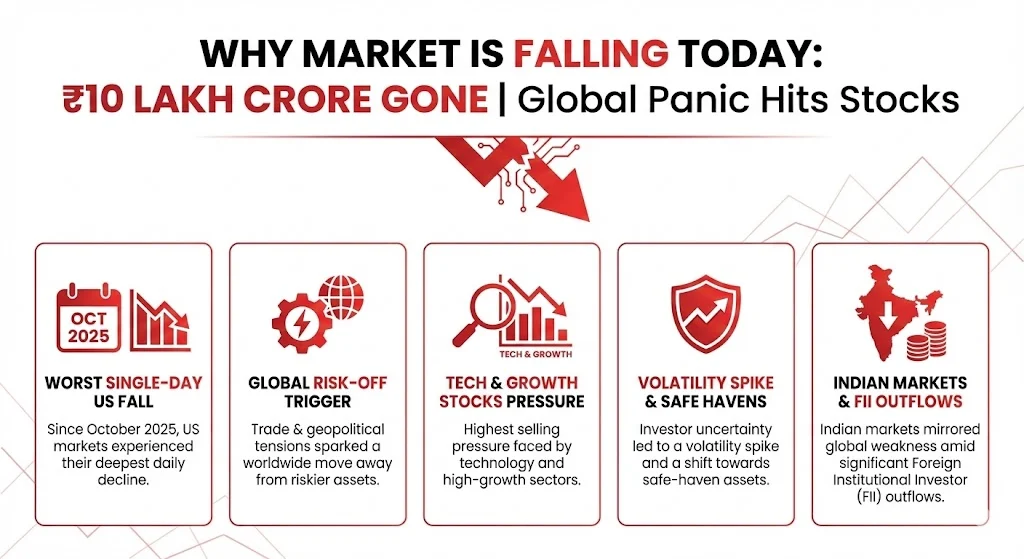
Table of Contents
Key Takeaways
- US markets saw their worst single-day fall since October 2025
- Trade and geopolitical tensions triggered a global risk-off move
- Technology and growth stocks faced the highest selling pressure
- Volatility spiked as investors moved towards safe-haven assets
- Indian markets mirrored global weakness amid FII outflows
Also Read: Tata Silver ETF Draws Strong Investor Focus as Silver Rally Extends Into 2026
Sharp Fall in US Markets Sets the Tone
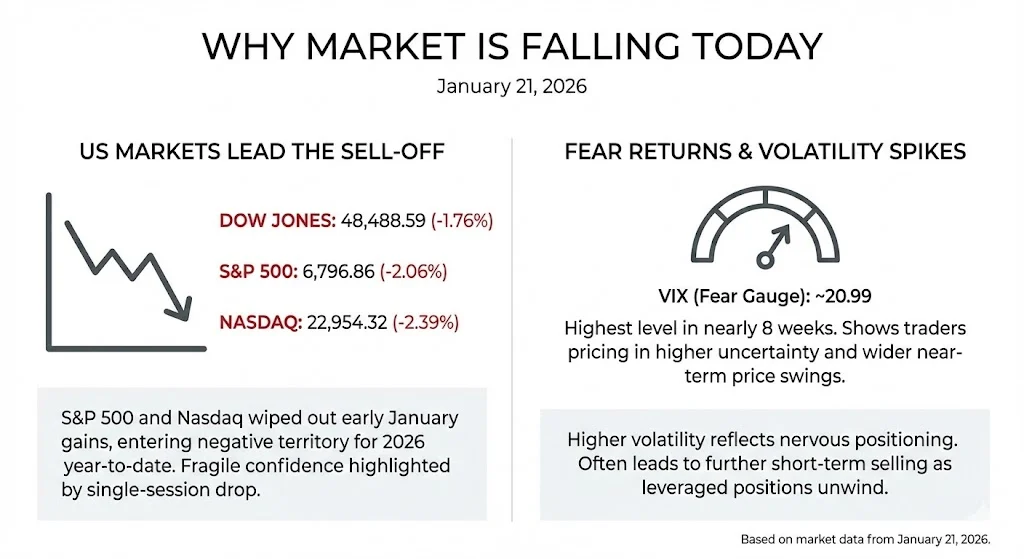
The selling pressure began in the United States, where major indices closed sharply lower. The Dow Jones Industrial Average fell 870.74 points or 1.76 percent to close at 48,488.59. The S&P 500 dropped 143.15 points or 2.06 percent to 6,796.86, while the Nasdaq Composite declined 561.07 points or 2.39 percent to 22,954.32.
This fall pushed both the S&P 500 and Nasdaq into negative territory for 2026 on a year-to-date basis. Recent optimism from early January was wiped out in a single session, highlighting how fragile market confidence remains.
Volatility Spikes as Fear Returns
The sudden selloff led to a sharp rise in volatility. The CBOE Volatility Index, often called the fear gauge, jumped to around 20.99, marking its highest level in nearly eight weeks. This rise shows that traders are now pricing in higher uncertainty and wider price swings in the near term.
Higher volatility usually reflects nervous positioning rather than long-term structural damage. Still, it often leads to further short-term selling as leveraged positions unwind.
Geopolitical Tensions Trigger Risk-Off Sentiment
The main trigger behind the fall was rising geopolitical and trade-related uncertainty. Fresh rhetoric from US President Donald Trump around acquiring Greenland from Denmark unsettled markets. Reports suggested possible new tariffs of up to 10 percent on imports from several European and NATO countries.
These statements revived fears of a renewed US-EU trade conflict. Investors reacted quickly as the possibility of retaliatory measures from Europe raised concerns about global trade disruption and slower economic growth.
Global Markets React in Unison
The impact was not limited to US equities. European and Asian markets also traded sharply lower as global investors moved away from risk assets. Selling was broad-based, covering banking, industrials, and technology stocks.
At the same time, safe-haven assets saw strong buying interest. Gold surged to record highs above $4,800 per ounce, while silver also moved higher. This shift highlights how investors are prioritising capital protection over returns in the current environment.
Tech Stocks Lead the Decline
Technology stocks faced the heaviest pressure during the selloff. The Nasdaq’s sharper decline compared to other indices reflects this trend. Large-cap technology names, including the so-called Magnificent Seven, came under selling pressure as investors reduced exposure to high-valuation stocks.
When uncertainty rises, growth and tech stocks usually see faster declines because they are more sensitive to interest rate expectations and risk sentiment.
Treasury Yields and Dollar Add to Pressure
US Treasury yields moved higher during the session as bonds were sold alongside equities. This steepening of the yield curve added another layer of discomfort for equity investors. Rising yields increase borrowing costs and reduce the attractiveness of future earnings.
The US dollar also weakened, signalling mixed capital flows and global repositioning. Currency volatility often adds to market stress, especially for emerging markets.
Indian Markets Follow Global Weakness
Indian equities mirrored the global selloff. The Sensex and Nifty closed sharply lower, with over ₹10 lakh crore wiped out from market capitalisation in a single session. Selling was seen across sectors, including banking, realty, defence, and mid-cap stocks.
Foreign institutional investors continued to sell Indian equities, adding pressure to already weak sentiment. The rupee also weakened, which further dented confidence among market participants.
Role of Earnings and Derivatives Expiry
The fall came during an early earnings season, where results from several companies have been mixed. Weak guidance from select large firms added to nervousness. At the same time, weekly derivatives expiry increased volatility as traders unwound and rolled over positions.
Expiry-day trading often amplifies market moves, and this session was no exception.
Public Sentiment Reflects Uncertainty ( Data Taken From X )
Reactions on social media platforms showed frustration and concern among investors. Many directly linked the fall to geopolitical headlines, while others pointed to deeper issues such as high debt levels, slowing consumer demand, and forced liquidations across asset classes.
Crypto markets also saw heavy selling, with over $150 billion reportedly wiped out from total market value. This confirmed a broader risk-off trend rather than an isolated equity market issue.
Is This a Temporary Correction or Something More
Some investors view the fall as a headline-driven correction that could reverse if tensions ease. Optimistic voices believe clarity from upcoming global meetings and policy signals may help stabilise markets.
Others remain cautious and warn that continued trade tensions could lead to further downside. With volatility rising and global cues weak, markets may remain under pressure in the short term.
What Investors Are Watching Next
Markets will now focus on developments around trade negotiations, global policy statements, and upcoming economic data. Any softening in geopolitical rhetoric could bring relief, while further escalation may deepen the selloff.
For now, sentiment remains cautious, and investors are closely tracking safe-haven flows, institutional activity, and global signals before taking fresh positions.
Tags: stock market today, market crash, global markets, sensex nifty, us stock market, investor sentiment
Related Posts :






Share This Post