Why l&t Share Price Is Falling? Kuwait Deal Shock

Why l&t Share Price Is Falling Kuwait Deal Shock | Image With Business Standard
Larsen and Toubro share price has seen a sharp fall in January 2026. The stock which was trading near its 52 week high only a few days ago has moved down fast. Many investors are now trying to understand what changed and why selling pressure suddenly came in.
The main trigger behind this fall is coming from overseas news. Reports from the Middle East have created uncertainty around one of L&T’s biggest oil and gas projects. This news hit the stock hard even though the company announced a fresh domestic order on the same day.
Table of Contents
Key Takeaways On L&T Share Fall
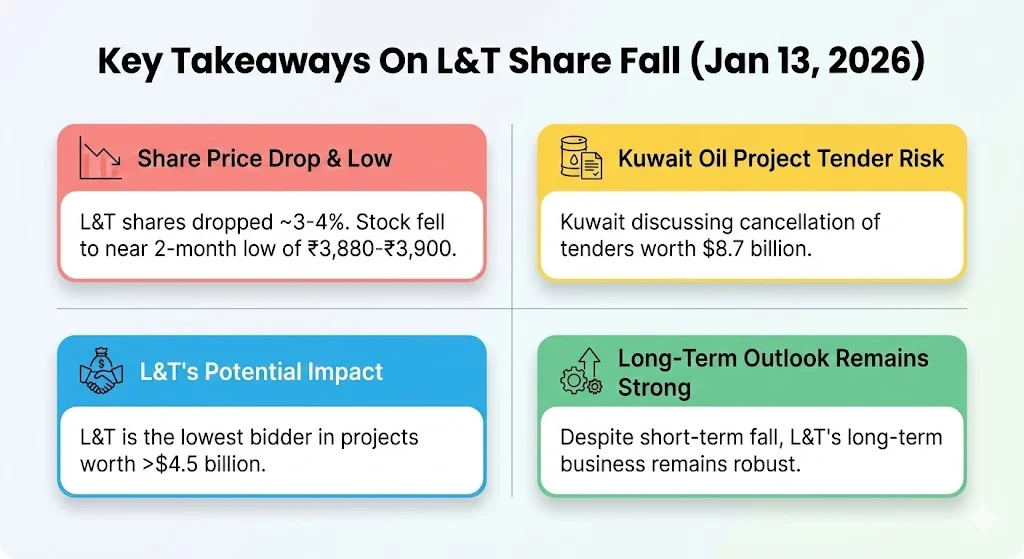
- L&T shares dropped around 3 to 4 percent on January 13, 2026
- Kuwait is discussing cancellation of oil project tenders worth $8.7 billion
- L&T is the lowest bidder in projects worth more than $4.5 billion
- Stock fell close to a two month low near ₹3,880 to ₹3,900
- Long term business outlook of L&T remains strong
What Triggered The Fall In L&T Share Price?
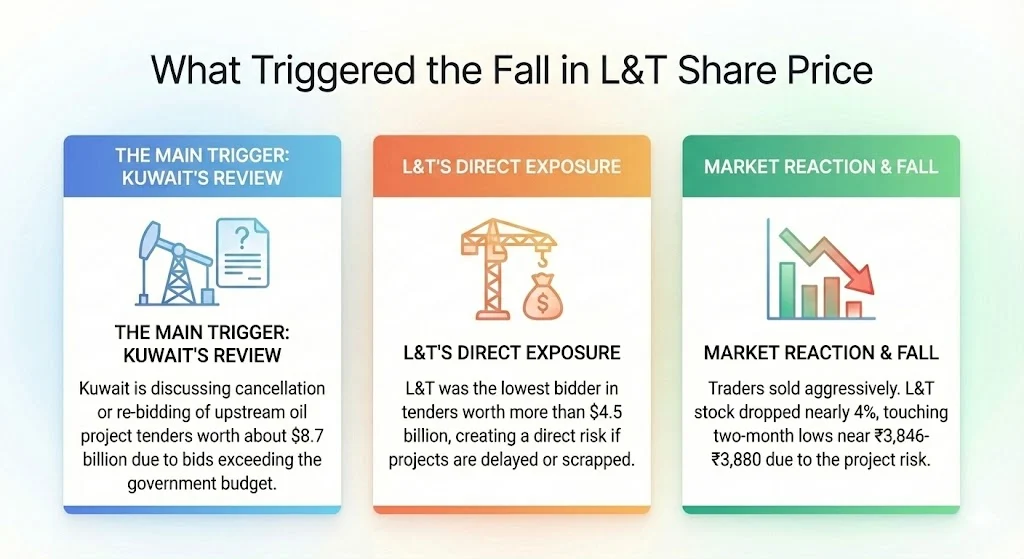
The main reason behind the fall is a report related to Kuwait’s oil sector. According to media reports, Kuwait is discussing the cancellation or re bidding of upstream oil project tenders worth about $8.7 billion. These contracts were offered earlier but the bids came in much higher than the government budget.
This created concern that some projects may be delayed or scrapped. Analysts also pointed out that L&T was the lowest bidder in tenders worth more than $4.5 billion. This means the company is directly exposed if Kuwait decides to cancel or change the contracts.
Because of this risk, traders started selling L&T shares aggressively. The stock dropped almost 4 percent during the day and touched levels near ₹3,846 to ₹3,880. This is the lowest level seen in nearly two months.
Also Read: Why Akums Drugs Share Is Falling Today – Complete Market Analysis
How the market reacted on January 13
On January 13, 2026, L&T shares opened weak and quickly moved lower. At one point the stock was trading near ₹3,879 on the NSE which was around 3.5 percent down for the day. Some sessions saw even deeper cuts of close to 4 percent.
This fall also pushed the stock around 7 to 8 percent lower from its recent 52 week high of ₹4,195 which was seen earlier in January. The sudden reversal made traders nervous as it came after a strong rally.
In the last few sessions before the fall, L&T was showing mild weakness. Once the Kuwait news came out, selling pressure increased across both cash and futures segments.
Key numbers linked to the Kuwait issue
Here is a simple view of the key figures that are worrying investors
| Detail | Value |
|---|---|
| Total Kuwait oil tenders under review | $8.7 billion |
| L&T lowest bidder exposure | Over $4.5 billion |
| Intraday fall on Jan 13 | Around 3 to 4 percent |
| Recent 52 week high | ₹4,195 |
| Recent low during fall | Around ₹3,846 to ₹3,900 |
These numbers show why the market reacted so fast. A large part of L&T’s international energy order pipeline is linked to the Middle East. Any disruption there can impact revenue visibility in the short term.
Why Kuwait tenders matter so much to L&T
L&T is not just an Indian infrastructure company. It is also a major global player in hydrocarbons, energy and heavy engineering. A big part of its growth in recent years has come from international markets, especially the Middle East.
As of September 2025, international orders made up nearly 49 percent of L&T’s order book. Within that, hydrocarbon and energy projects form a large share. Kuwait is one of the important markets for these projects.
So when news came that Kuwait is reviewing oil tenders worth billions of dollars, investors immediately saw risk to future revenue. Even if not all projects are cancelled, delays or re bidding can hurt cash flow and order execution.
What about L&T’s latest order win
On the same day when the stock was falling, L&T announced a fresh domestic order. The company’s transportation infrastructure division won a significant contract in West Bengal.
The project involves building a 2 plus 2 lane 3.2 km extradosed cable stayed bridge over the Muri Ganga River in South 24 Parganas district. It also includes approach roads of 0.9 km on the Kakdwip side and 0.65 km on the Sagar Island side.
The bridge will be equipped with advanced traffic management systems, bridge health monitoring, architectural lighting and hybrid street lighting. As per L&T’s classification, this is a significant order in the range of ₹1,000 crore to ₹2,500 crore.
This news is positive for the company but it was not enough to offset the fear coming from the Kuwait story.
Strong financials but short term worry
Even though the stock is falling, L&T’s financial performance remains solid. In Q2 FY26, the company reported strong numbers. Net profit grew by around 15.6 percent to ₹3,926 crore. Revenue also increased by about 10.4 percent to ₹67,983 crore.
These numbers show that the core business is performing well. Order execution remains healthy across infrastructure, energy and defense segments. However stock markets often react more to future risks than current results.
The Kuwait issue creates uncertainty around future international orders. That is why the stock corrected despite good quarterly performance.
What Traders Are Saying On Twitter
Public discussion on X shows that most traders link the fall directly to the Kuwait tender news. Many posts mentioned aggressive selling in futures and bearish signals from the order book.
Some traders pointed out possible support near ₹3,700 if selling continues. Others said this looks like a correction due to project risk and not a breakdown of the business.
Several market updates also highlighted that the stock fell around 3 percent to a one month low due to the Kuwait news. Long term investors on social media are treating this as a risk to monitor rather than a permanent problem.
Is This A Short Term Correction Or A Long Term Issue?
Most analysts believe this fall is a short term reaction. The risk from Kuwait is real but it does not change the long term strength of L&T. The company has a very large global pipeline.
For the energy projects segment alone, L&T has a near term prospects pipeline of around ₹3.57 trillion. This includes hydrocarbon prospects of ₹2.93 trillion, CarbonLite Solutions of ₹0.46 trillion and clean energy prospects of ₹0.18 trillion.
More than 90 percent of hydrocarbon opportunities are overseas. The Middle East still accounts for about 70 to 80 percent of these prospects. Even if one country delays projects, others remain active.
Other Factors Adding Pressure
Apart from Kuwait, there are a few other minor factors. Some analysts point to elevated debt and flat metrics in some recent periods. Broader market volatility has also played a role as indices have been swinging due to global cues and derivatives expiry.
Technical indicators like stochastic crossovers have also suggested some near term weakness. These signals often trigger selling from short term traders and algorithms.
All of this together created a setup where negative news could push the stock down quickly.
How L&T Shares Have Performed Recently
Before this fall, L&T had a strong run. Over the past six months, the stock is still up around 10 to 11 percent. On a year on year basis, it has gained around 12 percent.
In the last one month though, the share price has dropped around 4 to 5 percent. This shows that the current move is more of a correction after a rally rather than a collapse.
The 52 week low of the stock is around ₹2,965 which was seen in April 2025. Compared to that, the current level near ₹3,900 is still much higher.
What Investors Should Watch Now
The biggest thing to track is clarity from Kuwait. If tenders are confirmed and contracts move forward, the stock can recover quickly. If projects are cancelled or re bid, there could be some more pressure in the short term.
Investors should also watch L&T’s order inflow updates and management commentary. The company has already said it expects to exceed its FY26 order inflow guidance of 10 percent.
Domestic infrastructure spending in India also remains strong. That provides a stable base even if some international projects face delays.
Final View On L&T Share Fall
L&T share price is falling mainly because of uncertainty around Kuwait oil project tenders worth $8.7 billion. Since L&T is the lowest bidder in a large part of these projects, the market sees risk to future revenue and cash flow.
At the same time, the company continues to win domestic orders and post strong financial results. Long term business fundamentals remain intact. For now, the stock is going through a correction driven by external news rather than internal weakness.
This phase is being watched closely by both traders and long term investors as clarity on the Kuwait situation will decide the next major move.
Tags: L&T share price, Larsen and Toubro stock, Kuwait oil projects, Indian infrastructure stocks, NSE stocks, engineering companies
Related Posts :





Share This Post