The 15 x 1.5 Rule: Understanding The Graham Number In Value Investing
The 15 x 1.5 Rule: Understanding the Graham Number in Value Investing
The Graham Number, also known as the 15 x 1.5 Rule, is a well-known valuation concept in the world of value investing. It comes from the teachings of Benjamin Graham, who is often called the father of value investing. His core belief was simple. An investor should not pay too high a price for any stock, and there must always be a margin of safety in every investment decision.
The Graham Number gives a conservative estimate of the maximum fair price an investor should pay for a stock. It uses two key financial numbers. These are earnings per share and book value per share. When a stock trades below this price, it may be considered undervalued and worth further study.
Key Takeaways
- The Graham Number is based on Benjamin Graham’s rule of not paying more than 15x earnings and 1.5x book value
- The formula is √(22.5 × EPS × BVPS)
- The 22.5 factor comes from 15 × 1.5
- Stocks trading below the Graham Number may be undervalued
- The metric is mainly used by conservative or defensive investors
- It is often combined with other financial checks for confirmation
The Graham Number remains popular today because it focuses on discipline. It does not chase hype or speculation. Instead, it focuses on earnings strength and asset backing.
How the 15 x 1.5 Rule Works
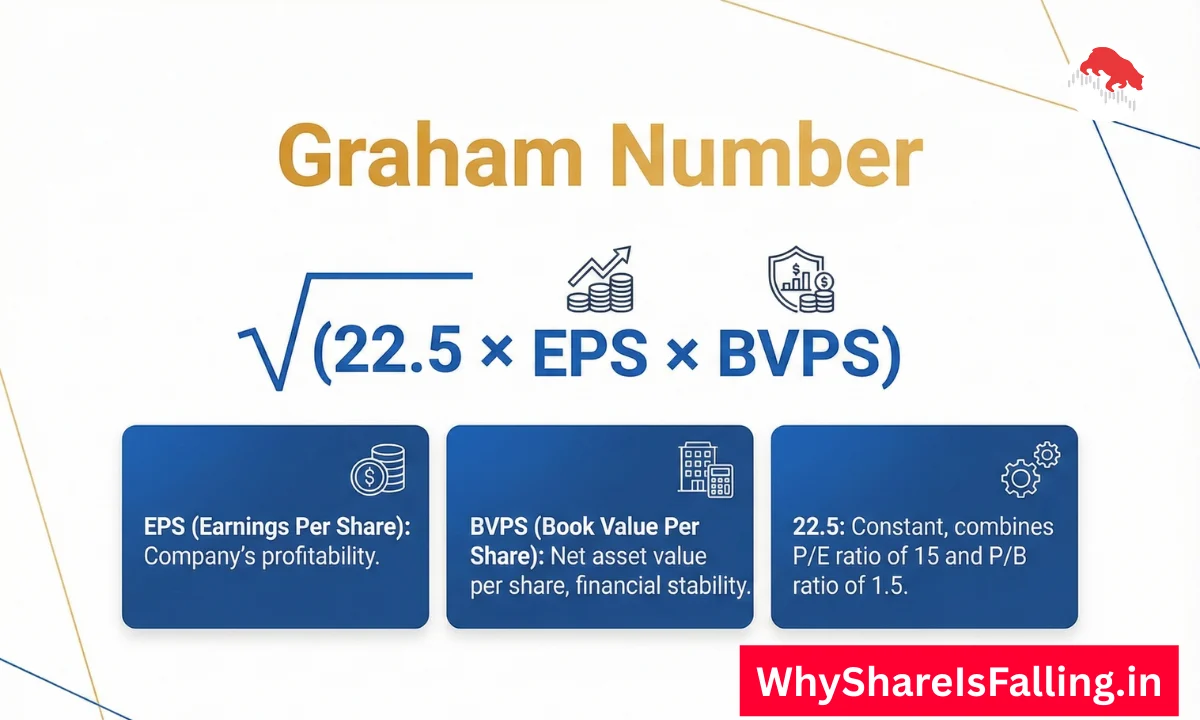
Benjamin Graham suggested two valuation limits. A stock should not trade at more than 15 times earnings. A stock should also not trade at more than 1.5 times book value.
When multiplied, these limits create the 22.5 factor used in the Graham Number.
Graham Number = √(22.5 × EPS × Book Value per Share)
This number represents the highest price that a defensive investor should consider paying. If the current stock price is higher, the investor is likely overpaying relative to earnings and assets. If it is lower, there may be value available.
Graham also encouraged investors to use average earnings over several years. This helps reduce the risk of distorted results from one unusual year.
Why Investors Still Follow the Graham Number
The Graham Number has become a core part of value investing education. It works as a quick valuation screen. It does not claim to be perfect. Instead, it helps narrow down stocks that deserve further research.
Investors like this approach because it is:
- Simple
- Conservative
- Focused on fundamentals
- Protective during market bubbles
In late 2025 and early 2026, interest in the Graham Number increased again. Market valuations were elevated due to strong growth stocks and AI-driven sectors. Value investors started using conservative screens to locate safer entry points. They wanted downside protection, not speculation.
Many investors paired the Graham Number with metrics like:
- Piotroski F-Score
- Altman Z-Score
- Debt ratios
- Earnings stability
This helped confirm whether the company truly had strong fundamentals.
Real-World Use Cases and Recent Discussions
Value investing communities online, including X (formerly Twitter), have continued to reference the Graham Number as a timeless filter. It has become common in educational threads, valuation discussions, and stock screen breakdowns.
Some users also apply modified forms of the Graham formula to include growth expectations. For example, one variation calculates intrinsic value as:
EPS × (8.5 + 2 × Growth Rate)
In several discussions, users highlighted stock examples such as Belrise Industries in India, which was cited as trading 77 percent below a modified Graham intrinsic value of around ₹651 based on a 30 percent growth assumption. This attracted attention from investors looking for undervalued auto ancillary plays.
Screens that search for:
- low-debt companies
- solid sales growth
- stocks trading below Graham value
have remained popular among conservative investors.
Public sentiment toward the Graham Number on X in late 2025 was largely positive. Users admire its discipline, simplicity, and emphasis on safety. It remains a respected core tool for anyone following value investing principles.
What Investors Admire Most About the Graham Number
Here is a short listicle summarizing why the Graham Number still attracts admiration among value-focused investors:
- Margin of safety
The rule encourages buying only when the price already contains a safety buffer. - Simplicity
It is easy to calculate using widely available data. - Timeless discipline
It helps investors avoid emotional buying during market hype. - Adaptability
Some investors now blend it with growth or macro adjustments to suit modern markets. - Strong relevance during corrections
Historical backtests show it performs well in weak or volatile markets.
Read More: 15 Unbeatable Rules To Be Undefeated In Investing & Budgeting
How the Graham Number Fits into Value Investing Strategy
The Graham Number is not meant to be the only metric. Graham himself warned against relying on a single number. He suggested using it as part of a wider research process.
Defensive investors often check:
- earnings stability
- dividend history
- financial strength
- business quality
The Graham Number is simply a valuation gatekeeper. If the price fails the test, the investor may walk away. This approach reflects Graham’s philosophy:
- Avoid major losses first.
- Seek reasonable gains second.
It rewards patience and careful selection.
Limitations You Should Know
The Graham Number also has limits. It works best for stable companies in traditional sectors. It may not be suitable for fast-growing tech companies or firms with large intangible assets.
Some limits include:
- It cannot be used when EPS or book value is negative
- It does not consider future growth
- It may undervalue innovative businesses
- It relies on historical data
- It assumes market conditions similar to Graham’s era
Modern investors often use it as a starting screen, then include growth models, cash flow analysis, or industry-specific metrics.
Why the Rule Still Matters in 2026
Even in an age of high-growth storytelling, conservative investing tools remain important. The Graham Number appeals to investors who prefer protection and rational pricing.
In early 2026, many users on X admire the formula for:
- reducing emotional bias
- focusing on real value
- encouraging long-term thinking
It stands as a reminder that price matters. Growth can fail. Markets can turn. But discipline endures.
Related Search Trends
Users researching the Graham Number also explore:
- Graham Formula
- Modified Graham Formula
- Intrinsic Value via Graham
- Margin of Safety
- Value Investing 2025 and 2026
- Undervalued Stocks via Graham Number
These searches show consistent interest in conservative valuation tools across global markets.
Final Thoughts
The 15 x 1.5 Rule, or the Graham Number, remains one of the most respected valuation tools in fundamental investing. It offers a disciplined way to estimate the maximum price a defensive investor should pay for a stock. Its core message is simple. Do not overpay. Always maintain a margin of safety.
Although modern markets have evolved, the Graham Number continues to guide patient investors who value stability over speculation. When used together with broader analysis, it can help identify undervalued stocks that offer protection and potential upside.
Value investing has always been about buying quality at a fair or discounted price. The Graham Number keeps that principle alive.
Tags: value investing, graham number, stock valuation, margin of safety, investing strategies, fundamental analysis
Related Posts :






Share This Post