SBI Share Price: Why The Stock Hit Record High And Then Slid Sharply After Budget 2026
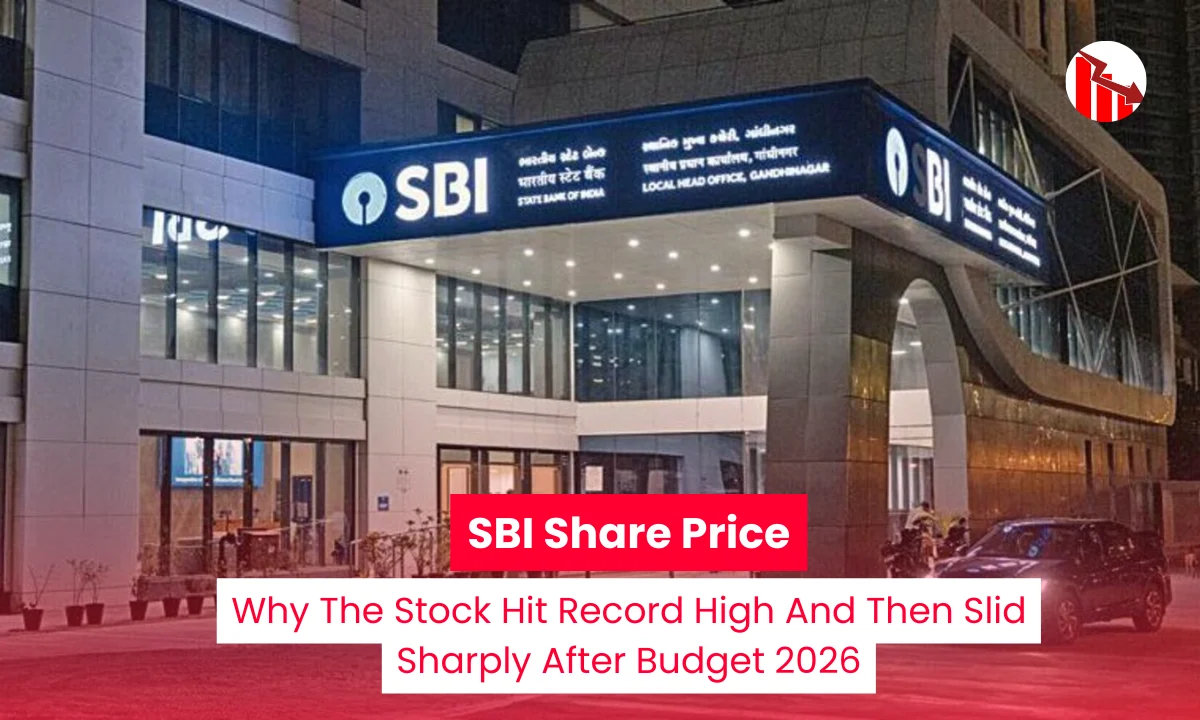
SBI Share Price: Why The Stock Hit Record High And Then Slid Sharply After Budget 2026 | Image With Live Mint
SBI share price remained in focus after touching a fresh all time high near ₹1,083 and then falling sharply in the same trading session. The sudden movement surprised many investors because State Bank of India had shown strong performance for months. Market participants closely tracked SBI share price after Budget 2026 announcements, which changed expectations around banking reforms and government borrowing.
The stock opened strong but faced heavy selling pressure as broader markets turned volatile. PSU bank stocks moved lower together, and SBI became one of the most traded counters of the day. Investors are now trying to understand whether this fall is a short term reaction or a shift in trend.
Key Takeaways
- SBI share price touched a new record high before falling nearly 5 to 8 percent intraday.
- Budget 2026 borrowing plans and bond yield rise impacted PSU banks.
- Long term fundamentals of SBI remain stable with strong asset quality.
- Public opinion shows optimism for long term and caution for short term volatility.
- CHAKRA initiative highlights SBI focus on sunrise sectors and future growth.
Also Read: RVNL Share Price Today: Why Railway Stocks Are Falling Despite Budget Expectations
SBI Share Price Performance Around Budget 2026
SBI share price showed extreme volatility on Budget Day 2026. The stock reached a new lifetime high above ₹1,083 during the session. Market capitalization also approached ₹10 trillion at peak levels. Soon after, selling pressure emerged across PSU banks.
By the end of the session, SBI share price traded close to ₹1,020 to ₹1,030 levels. This meant a fall of around 4 to 5 percent from the day’s high. In some intraday trades, losses touched nearly 8 percent.
This movement was not limited to SBI alone. Other PSU banks like Bank of Baroda and Canara Bank also saw sharp declines. The Nifty PSU Bank index dropped close to 7 percent at its lowest point.
The fall came after a strong rally in recent months. Over the past six months, SBI had gained more than 30 percent. In the last one year, returns crossed 40 percent in many market calculations. Profit booking became natural after such a sharp run up.
Key Reasons Behind The Sudden Fall In SBI Share Price
Several factors combined to push SBI share price lower after the Budget announcement. These reasons were linked to policy expectations, bond market reaction, and overall market mood.
Main Reasons For The Decline
- Disappointment over lack of immediate PSU bank reforms
- Higher government borrowing announced in the Budget
- Rising bond yields affecting bank bond portfolios
- Profit booking after recent rally
- Weak sentiment in broader banking stocks
Investors were expecting some strong announcements for PSU banks. One of the key expectations was an increase in the Foreign Direct Investment limit in public sector banks. The Budget did not announce any immediate change in this area.
The government also announced a large borrowing plan of around ₹17.2 lakh crore for the coming financial year. This pushed bond yields higher. When bond yields rise, the value of existing government securities held by banks falls. PSU banks hold large bond portfolios, so this directly impacts sentiment.
At the same time, traders preferred to exit positions in sectors that did not receive strong short term triggers from the Budget. SBI had already delivered strong gains before the event, which increased selling pressure.
SBI Fundamentals Remain Strong Despite Market Reaction
Even though SBI share price corrected sharply, the bank’s fundamentals stayed solid. Analysts continue to highlight asset quality, loan growth, and valuation comfort.
SBI’s price to earnings ratio remains around 12. This is considered reasonable for a market leader in PSU banking. Gross non performing assets are low compared to past years. Provision coverage ratio remains healthy.
Retail, agriculture, and MSME loan growth continues to support earnings. Credit costs are expected to remain under control in the coming years. Many analysts project stable growth for FY26 to FY28.
SBI Key Financial Snapshot
| Metric | Recent Status |
|---|---|
| 52 Week High | ₹1,083+ |
| 52 Week Low | ₹680 |
| PE Ratio | Around 11.8 to 12.3 |
| Market Capitalization | ₹9.4 to ₹9.9 lakh crore |
| 6 Month Performance | Around +36 percent |
| 1 Year Performance | Around +40 percent |
These numbers show that SBI remains among the strongest performers in the banking sector. It has also outperformed many private banks in 2026 so far.
CHAKRA Initiative And Long Term Growth Outlook
Another important development supporting long term optimism is SBI’s launch of CHAKRA. This is a Centre of Excellence focused on financing sunrise sectors.
CHAKRA aims to support sectors that are expected to drive India’s future economic growth. These include renewable energy, battery storage, semiconductors, electric mobility, green hydrogen, smart infrastructure, and data centres.
SBI estimates that these sectors could attract investment of nearly ₹100 trillion over the next five years. Out of this, SBI sees a lending opportunity of around ₹20 to ₹22 trillion.
The bank has signed agreements with more than 21 financial institutions. These include domestic lenders and international banks. Project finance teams will work together to design better funding structures for new industries.
This move shows SBI’s focus on innovation and sustainability based growth. It also highlights the bank’s effort to build expertise in emerging sectors instead of relying only on traditional lending.
How SBI Compares With Other Banks In 2026
SBI has outperformed many private sector banks in recent months. While some large private banks saw weaker returns in early 2026, PSU banks gained momentum.
SBI also played a key role in market recoveries from intraday lows. On several sessions, when the Nifty rebounded, SBI was among the top contributors.
However, during banking sector weakness, SBI also faced selling pressure due to its heavyweight status. This makes it both a support and risk factor for the index.
Comparison Snapshot
| Bank Category | Performance Trend |
|---|---|
| PSU Banks | Strong rally with volatility |
| Private Banks | Mixed performance |
| SBI | Outperformed peers in many sessions |
This comparison shows why SBI remains in focus for both traders and long term investors.
Public Opinion From Twitter On SBI Share Price (Data Taken From X)
Public opinion on Twitter reflects a mix of confidence and caution. Many traders praised SBI for hitting new highs and delivering strong positional trade results. Some shared successful trade setups with high win rates.
Others pointed out SBI’s role in lifting the Nifty from intraday lows during market recoveries. There was admiration for its resilience compared to private banks.
At the same time, several users warned about short term risks due to PSU bank weakness and bond yield pressure. Some investors advised gradual profit booking after strong rallies.
Overall sentiment shows respect for SBI’s long term strength and awareness of near term volatility.
What People Are Admiring
- Consistent long term growth
- Strong asset quality
- Leadership in PSU banking
- Ability to recover from market dips
- Contribution to index stability
What People Are Cautious About
- Budget related uncertainty
- PSU bank sector weakness
- Global market cues
- Bond yield impact
This balance of views makes SBI a widely discussed stock among retail and institutional participants.
Is The Fall A Short Term Reaction Or A Trend Change
Market experts believe the recent fall is more of a reaction to Budget related factors and profit booking. There is no major negative change in SBI’s business outlook.
Long term drivers such as loan growth, asset quality improvement, and focus on sunrise sectors remain intact. Volatility is expected to continue as markets digest fiscal and global cues.
For investors, the focus remains on fundamentals rather than daily price movement. Traders may see sharp swings, while long term holders may track quarterly performance and sector trends.
What Investors Should Watch Going Forward
Investors will closely monitor a few important points in the coming months.
Key Factors To Track
- Bond yield movement and its impact on bank portfolios
- Credit growth in retail and MSME segments
- Government policy signals on PSU bank reforms
- Progress of CHAKRA initiative and new sector lending
- Global market and interest rate trends
These factors will shape the next phase of SBI share price movement.
Conclusion
SBI share price touched record highs before facing a sharp fall due to Budget 2026 reactions, higher borrowing plans, and profit booking. While short term volatility remains high, the bank’s fundamentals continue to stay strong.
The launch of CHAKRA and focus on sunrise sectors adds a new long term growth angle for SBI. Public opinion reflects optimism about its leadership position and caution about near term swings.
For the market, SBI remains a heavyweight stock that reflects both economic confidence and financial sector sentiment. Its journey ahead will depend on how well it balances stability with innovation in a changing financial landscape.
Tags: SBI share price, PSU bank stocks, Budget 2026 impact, Indian banking sector, sunrise sectors, stock market volatility, SBI fundamentals
Related Posts :





Share This Post