RVNL Share Price Today: Why Railway Stocks Are Falling Despite Budget Expectations
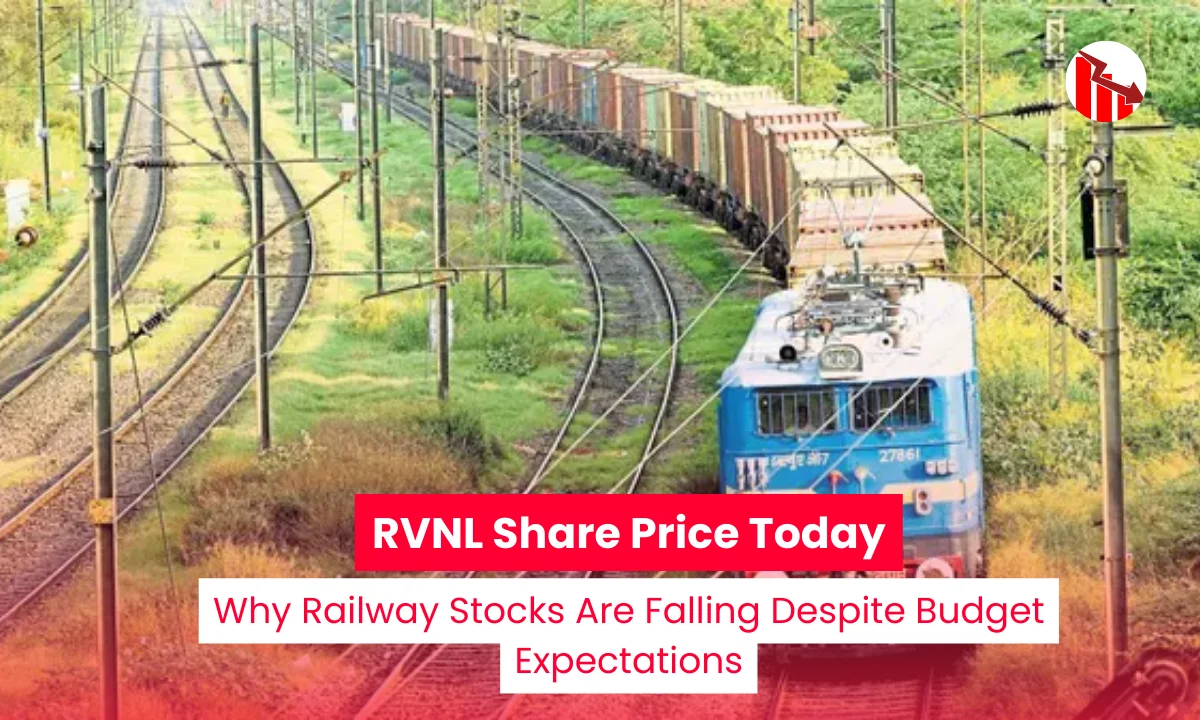
RVNL Share Price Today: Why Railway Stocks Are Falling Despite Budget Expectations | Image With Live Mint
RVNL share price today is under pressure as railway stocks react to Union Budget 2026 announcements and rising market volatility. Investors searching for “RVNL share price today” and “RVNL target price” are trying to understand why the stock is moving lower even when the government continues to focus on infrastructure and railway development.
Recent trading sessions show that RVNL has faced sharp intraday swings with heavy volumes. This reflects uncertainty among traders and long-term investors who expected stronger positive signals from the Budget. At the same time, public discussions on social platforms show a mix of optimism for long-term railway growth and caution over high valuation and short-term corrections.
Key Takeaways
- RVNL share price has seen high volatility and short-term decline after Budget 2026.
- Railway sector allocation increased by around 10 percent, but no major surprise announcements were made.
- Valuation concerns and subdued earnings are weighing on sentiment.
- Public opinion remains cautiously optimistic for the long term.
- Budget-linked trading and derivatives activity indicate high risk and uncertainty.
Also Read: Semiconductor Stocks: Budget 2026 Sparks Fresh Rally And Renewed Investor Confidenc
Current RVNL Share Price Performance
The share price of Rail Vikas Nigam Limited has shown wide intraday movement in early February 2026. The stock opened near the previous close but soon slipped into a lower range.
Key price observations include:
- Previous close around ₹341 to ₹343
- Intraday low near ₹309 to ₹310
- Intraday high around ₹351 to ₹352
- Last traded levels around ₹325 to ₹330
- High trading volume crossing 25 million shares in several sessions
This movement shows that RVNL is not following a steady trend. Instead, it is reacting to news flow, budget expectations, and broader market sentiment.
Why Railway Stocks Are Under Pressure
Railway stocks such as RVNL, IRFC, IRCTC, RailTel, and Titagarh Rail have declined since the last Budget cycle. Analysts link this weakness to two main reasons.
High Valuation Levels
RVNL is trading at a high price-to-earnings ratio compared to historical averages. A P/E near 60 to 64 times indicates that the stock is priced for strong growth. When earnings growth does not match expectations, stocks tend to correct.
Subdued Quarterly Earnings
Recent quarterly performance of many railway companies has not shown sharp improvement. This has reduced short-term confidence among investors who expected faster profit growth from government projects.
Union Budget 2026 And Its Impact On RVNL
The Union Budget 2026 announced a higher allocation for the railway sector. Total funding is expected to rise close to ₹2.93 lakh crore, showing about a 10 percent increase from the previous year.
Major Budget Highlights For Railways
| Category | Allocation Change |
|---|---|
| New Lines | Increased to ₹36,722 crore |
| Gauge Conversion | Marginal increase to ₹4,600 crore |
| Rolling Stock | Increased to ₹52,109 crore |
| Signaling And Telecom | Higher by ₹500 to ₹1,000 crore |
| High Speed Rail Corridors | 7 new corridors announced |
While these numbers support long-term development, markets reacted negatively because there were no major announcements on new trains or large flagship programs like Vande Bharat expansion.
High Speed Rail Corridors And Long Term Potential
One positive aspect from the Budget was the announcement of seven high-speed rail corridors. These corridors will connect major cities such as Mumbai, Pune, Hyderabad, Bengaluru, Chennai, Delhi, and Varanasi.
The government also proposed a new dedicated freight corridor between Dankuni and Surat. These projects are expected to boost railway modernization and logistics efficiency over time.
For RVNL, this means potential future contracts in:
- Track development
- Electrification
- Signaling systems
- Freight corridor infrastructure
However, such benefits are long-term in nature and not immediately reflected in share price movement.
Short Term Trading Sentiment And Volatility
RVNL has become a popular stock for budget-linked trading. Options market activity shows rising premiums and high implied volatility. This suggests that traders are expecting sharp price movements in either direction.
Some traders view RVNL as a “budget execution stock,” while others see it as risky due to current price correction. This mixed behavior leads to unstable price action and sudden spikes or drops.
Public Opinion From Twitter And Social Media
(Data Taken From X)
Public discussion around RVNL remains active, especially during the Budget period. Most posts reflect a combination of hope and caution.
Common themes in public opinion include:
- Belief that RVNL will benefit from long-term railway and infrastructure growth.
- Focus on government backing and strong order book potential.
- Concerns about recent price decline and high valuation.
- Traders discussing budget volatility and short-term options strategies.
Many users consider the current price range as a possible entry point for those who believe in the railway sector story. At the same time, others warn about further downside if earnings do not improve.
RVNL Compared With Other Railway Stocks
Investors often compare RVNL with peers such as IRCON, RailTel, Titagarh Rail, and IRFC. These stocks have also seen corrections since the last Budget.
A simple comparison trend:
| Company | 1 Year Trend | Key Driver |
|---|---|---|
| RVNL | Down 20 to 28 percent | Valuation and earnings |
| IRFC | Down around 12 percent | Interest rate sensitivity |
| IRCTC | Down near 19 percent | Tourism and catering margins |
| Titagarh Rail | Down around 9 percent | Manufacturing cycle |
This shows that RVNL’s weakness is not isolated. It reflects a sector-wide adjustment phase.
What Investors Are Searching For Now
Search trends show growing interest in:
- RVNL share price today
- RVNL target price
- RVNL stock news
- Railway stocks budget 2026
- RVNL vs IRCON
This indicates that investors are looking for clarity on direction and long-term value rather than only short-term price action.
Risks To Watch In The Near Term
Some important risks include:
- Global economic uncertainty affecting equity markets
- Rising crude oil prices
- Interest rate outlook in the US
- Delay in project execution
- Pressure on margins due to high costs
These factors can influence railway stocks even when domestic policy remains supportive.
Outlook For RVNL Share Price
The current trend shows short-term weakness and high volatility. In the medium to long term, RVNL remains linked to India’s railway modernization and infrastructure spending plans.
The stock’s future performance will depend on:
- Execution of announced railway projects
- Order inflow growth
- Improvement in earnings
- Stability in broader markets
For now, sentiment remains cautious with optimism focused on long-term potential rather than immediate gains.
Tags: RVNL share price, railway stocks India, Union Budget 2026, infrastructure stocks, RVNL stock news, railway sector outlook, public sector stocks
Related Posts :




Share This Post