Ray Dalio New World Order: Is The World Really Entering Stage 6 Of The Big Cycle?
Ray Dalio New World Order: Is The World Really Entering Stage 6 Of The Big Cycle?
The question “Is the world entering a new world order?” is not just trending. It is becoming serious dinner table conversation. When Ray Dalio says the post 1945 global system has broken down, people listen. After all, he is the founder of Bridgewater Associates and someone who studies history like a data scientist, not a headline chaser.
Over the past few weeks, his statements around the Munich Security Conference 2026 and the idea that we are now in “Stage 6” of his Big Cycle have gone viral. Investors, crypto communities, policy watchers and even common users on X are debating what this actually means. Is this just another macro warning? Or are we genuinely entering a new global era?
Key Takeaways
- Ray Dalio believes the post World War II order is effectively over
- He says we are in Stage 6 of the Big Cycle marked by great disorder
- Signs include rising US China tensions, debt crises, trade wars and asset freezes
- Gold is preferred over crypto in times of systemic breakdown
- Public opinion on X shows fear, agreement, skepticism and opportunism
- Historical parallels include transitions from Dutch to British and British to US dominance
- Investors are advised to focus on resilience, diversification and lower debt exposure
Understanding Ray Dalio And The Big Cycle Framework
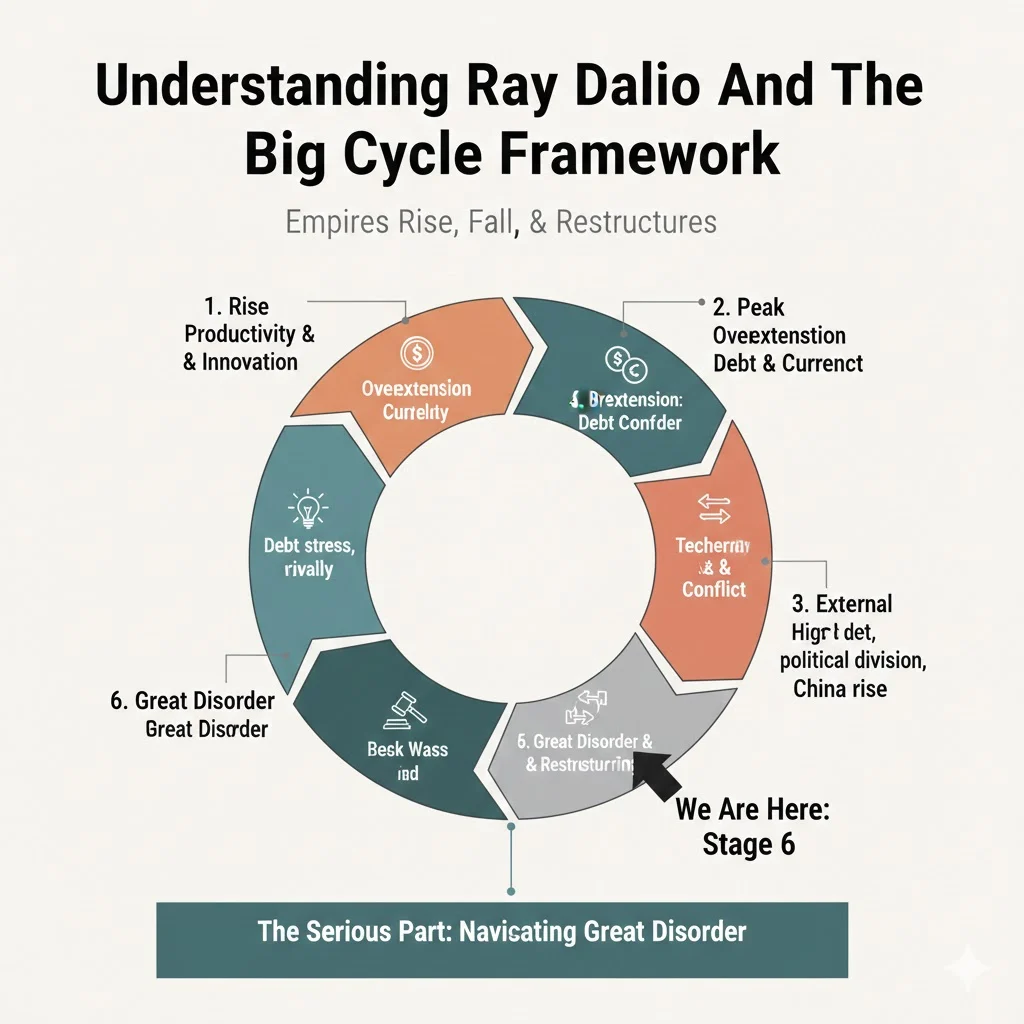
Ray Dalio, founder of Bridgewater Associates and author of Principles for Dealing with the Changing World Order, argues that global empires rise and fall in predictable cycles. He calls this the Big Cycle.
According to Dalio, every dominant power goes through similar stages:
- Rise through productivity, innovation and strong education
- Peak dominance with reserve currency status
- Overextension via high debt and internal conflict
- External challenges from rising powers
- Breakdown of rules based order
- Great disorder and eventual restructuring
He now says we are in Stage 6.
That is the serious part.
What Does Stage 6 Actually Mean?
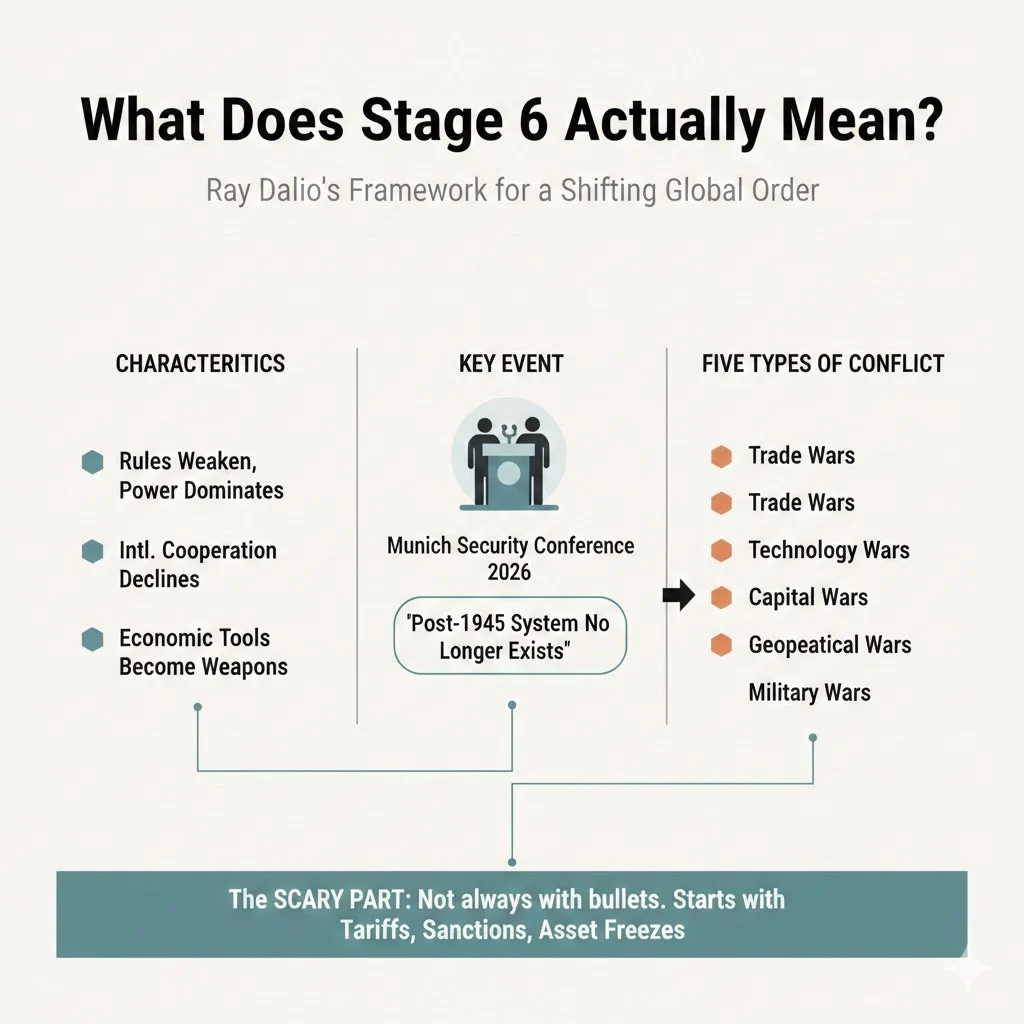
Dalio describes Stage 6 as a period where rules weaken and power dominates. International cooperation declines. Economic tools become weapons.
At the Munich Security Conference 2026, leaders openly acknowledged that the old post 1945 system no longer exists. When statements like that come from major global leaders, it signals structural change, not just political drama.
Dalio connects this to five types of conflict:
- Trade wars
- Technology wars
- Capital wars
- Geopolitical wars
- Military wars
The scary part is that these wars do not always begin with bullets. They start with tariffs, sanctions, asset freezes and capital restrictions.
Also Read: New RBI Credit Rules For Brokers: Big Shift In Leverage Game From April 2026
Historical Parallels That Dalio Points Out
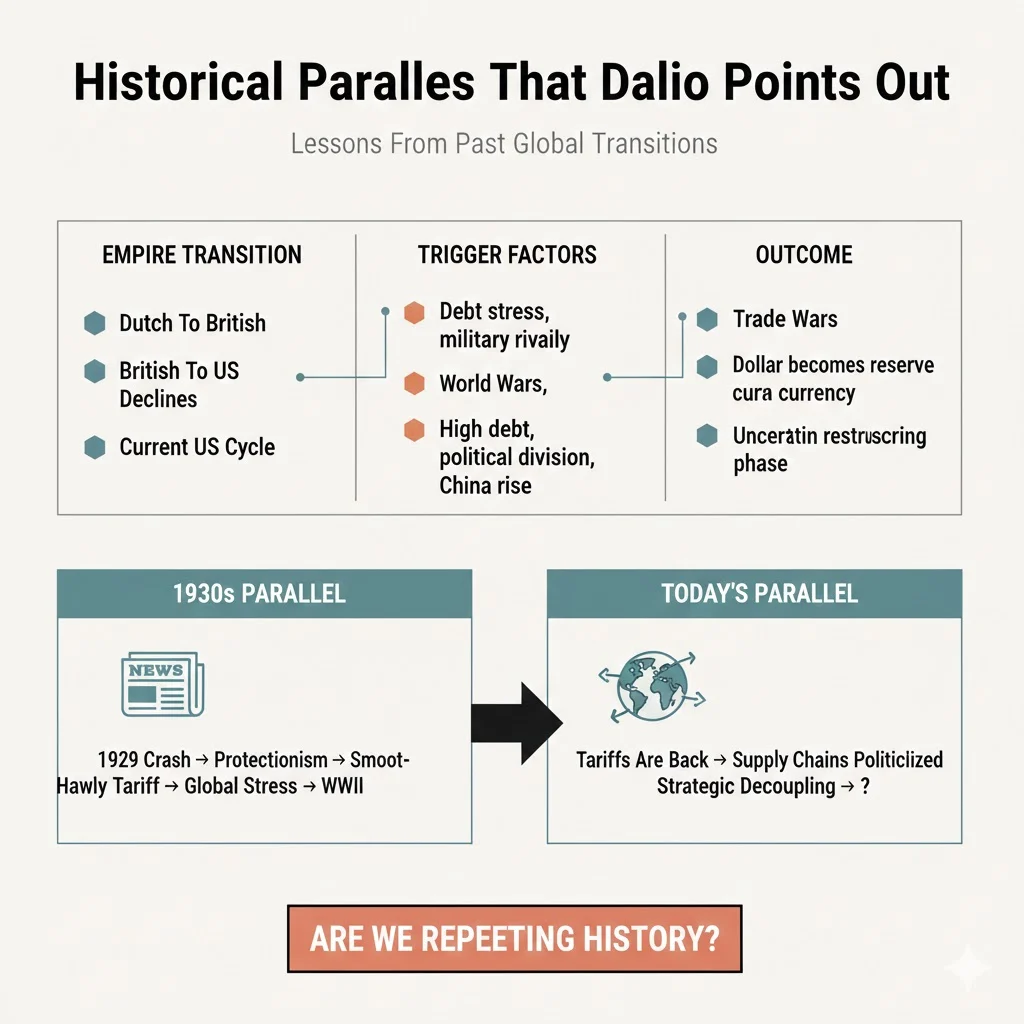
Dalio does not make emotional predictions. He uses historical data. He compares today’s situation to past transitions:
| Empire Transition | Trigger Factors | Outcome |
|---|---|---|
| Dutch To British | Debt stress, military rivalry | Shift in trade dominance |
| British To US | World Wars, financial restructuring | Dollar becomes reserve currency |
| Current US Cycle | High debt, political division, China rise | Uncertain restructuring phase |
He also draws parallels to the 1930s. After the 1929 crash, protectionism rose. The Smoot Hawley Tariff Act deepened global stress. That period eventually led to World War II.
Now look around. Tariffs are back. Supply chains are politicised. Countries talk openly about strategic decoupling.
It feels familiar.
Also Read: Upcoming IPO This Month In India: February 2026 Mini IPO Season Is Here
Debt, Fiat Money And The Risk Of Capital Wars
One major pillar of Dalio’s warning is debt. He argues that when government debt becomes too large, central banks print money to manage it. This weakens fiat currencies over time.
When trust in money declines, countries start using financial systems as weapons. We already see:
- Asset freezes
- Sanctions
- Restricted access to capital markets
- Payment system weaponisation
This is what he calls capital wars.
And honestly, many investors are quietly nervous about this.
Gold vs Crypto Debate
Another hot topic is gold versus Bitcoin.
Dalio clearly leans toward gold during periods of systemic breakdown. His reasoning is simple:
- Gold has survived every major monetary reset
- Central banks hold gold
- Gold does not rely on digital networks
Crypto communities on X disagree. Many argue that decentralized assets gain importance when trust in governments declines. Some posts even say, “When trust falls, neutral assets win.”
The sentiment is split.
Here is a simplified comparison:
| Factor | Gold | Bitcoin |
|---|---|---|
| Central Bank Adoption | High | Very Low |
| Historical Track Record | Thousands of years | Around 15 years |
| Network Dependence | None | High |
| Regulation Exposure | Low | Medium To High |
Dalio is not anti crypto. He just believes gold is more proven during global restructuring.
Public Opinion On X What People Are Saying
Public reaction is mixed and very telling.
Many users praise Dalio’s long term thinking. They call his book one of the best frameworks for understanding macro history. Some posts summarize his views in five points and end with lines like “May God save us all.” That shows genuine concern.
Crypto investors see opportunity. They argue that declining trust in global institutions is bullish for decentralized assets.
Some users are skeptical. They say Dalio has been talking about a new world order for decades. According to them, this is evolution, not sudden collapse.
What is interesting is the emotional tone. It ranges from fear to excitement to calm strategic preparation.
That itself signals uncertainty.
Is The US Losing Dominance
Dalio often mentions that reserve currency status is a key indicator of power. The US dollar has held that role since World War II.
But central banks have slowly increased gold reserves. There is also discussion around de dollarization and alternative trade settlement systems.
That does not mean the dollar collapses tomorrow. It means the system is adjusting.
Historically, these transitions take years. Sometimes decades.
Investment Implications In A New World Order
Dalio suggests focusing on resilience rather than speculation.
His broad themes include:
- Geographic diversification
- Lower reliance on debt
- Owning hard assets
- Building globally valuable skills
- Maintaining mobility
He also suggests that during unstable times, survival beats innovation hype.
This does not mean panic. It means being practical.
Are We Really Entering A New World Order
This is the core question.
Based on Dalio’s framework, yes, we are in a transition phase. But transition does not mean instant collapse. It means rules are being rewritten.
The post 1945 rules based system shaped trade, security alliances and global finance for decades. If leaders now openly say that system is over, it suggests structural change.
History shows that new orders emerge after conflict and restructuring. The key uncertainty is how smooth or chaotic that transition will be.
Right now, we see:
- Rising geopolitical rivalry
- Higher global debt levels
- Internal political polarization
- Strategic resource competition
- Financial weaponisation
Those match many historical indicators of late cycle dynamics.
Final Thoughts
Ray Dalio is not predicting apocalypse. He is describing patterns. His data driven approach explains why so many people take him seriously.
Whether you agree fully or not, ignoring historical cycles is risky. The conversation is no longer fringe. It is mainstream.
Are we entering a new world order?
If we define it as a restructuring of global power, finance and alliances, then signs clearly point in that direction. The bigger question is how individuals, businesses and nations adapt to it.
And that part is still being written.
Related Posts :




Share This Post