Income Tax Refund News January 2026: Why Lakhs of Taxpayers Are Still Waiting
Income Tax Refund News January 2026: Why Lakhs of Taxpayers Are Still Waiting
Income tax refund news has become one of the most discussed financial topics in India as January 2026 progresses. A large number of taxpayers who filed their income tax returns on time are still waiting for their refunds. The delay has created stress among salaried employees and middle class families who depend on refunds for household and financial planning.
Public frustration is visible across social media platforms, especially on X, where taxpayers are openly questioning the slow pace of refund processing. Even though returns have been verified, many refunds remain stuck at the processing stage, raising concerns about efficiency and accountability.
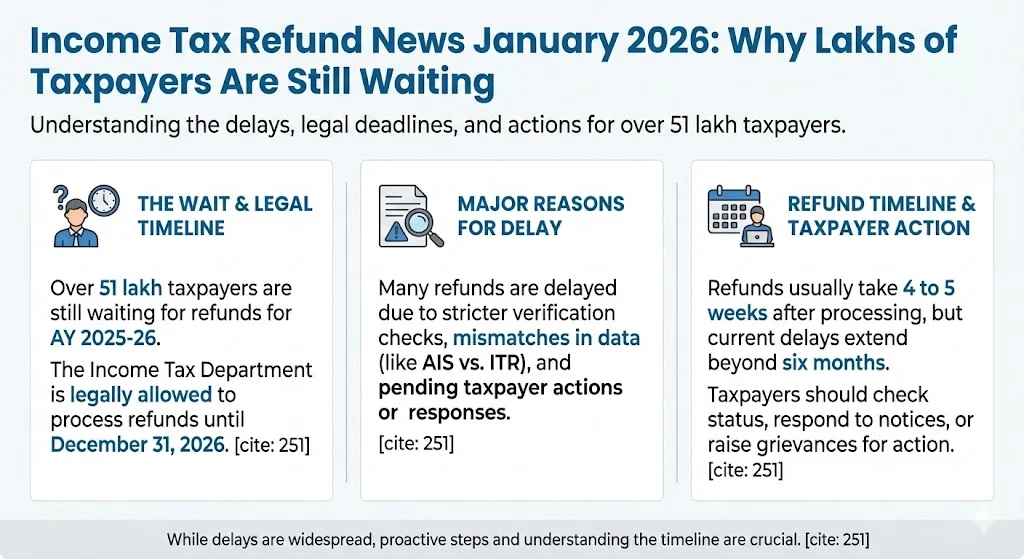
Table of Contents
Key takeaways
- Over 51 lakh taxpayers are still waiting for income tax refunds for AY 2025-26
- The Income Tax Department is legally allowed to process refunds until December 31, 2026
- Many refunds are delayed due to verification checks, mismatches, and pending actions
- Refunds usually take 4 to 5 weeks after processing, but delays now extend beyond six months
- Taxpayers can take action by checking status, responding to notices, or raising grievances
How Many Income Tax Refunds Are Still Pending?
As per the latest available data in mid January 2026, the scale of pending refunds is significant. Around 8.80 crore income tax returns were filed for Assessment Year 2025-26. Out of these, nearly 8.69 crore returns were verified.
However, only about 8.17 crore returns have been processed so far. This means more than 51 lakh taxpayers are still waiting for their income tax refund. Some estimates even place the pending number closer to 53 lakh returns.
This gap between filing and processing has become the core reason behind growing dissatisfaction. Many taxpayers who filed returns between July and September 2025 report that they are still waiting, even after six months.
Also Read: 8th Pay Commission Salary Hike: Latest Update, Fitment Factor Estimates and Realistic Timeline
What The Law Says About Income Tax Refund Timelines?
Under the Income Tax Act, the Income Tax Department is allowed to process income tax returns and issue refunds until December 31, 2026, for returns filed in Financial Year 2024-25.
The Centralised Processing Centre is required to issue an intimation under Section 143(1) within nine months from the end of the financial year in which the return is filed. This means that even if a return was filed early, the department is still operating within the legal time limit.
While this provides legal cover to the department, taxpayers argue that legality does not reduce financial pressure or uncertainty caused by long waiting periods.
Why Income Tax Refunds Are Getting Delayed In 2026
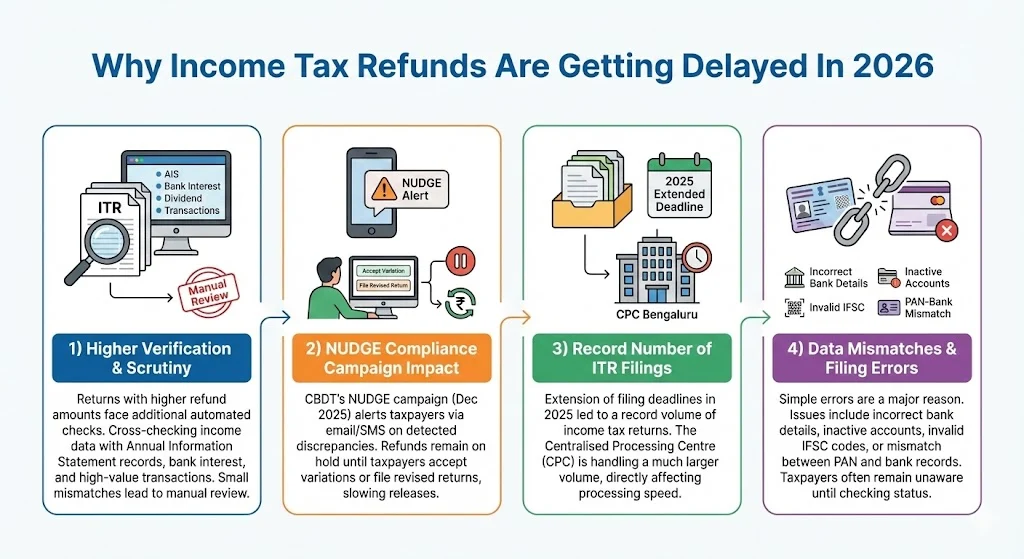
Income tax refund delays in 2026 are not due to a single factor. Multiple operational and compliance related issues are contributing to the slowdown.
1) Higher verification and scrutiny
Returns involving higher refund amounts are subjected to additional automated checks. The department cross checks income data with Annual Information Statement records, bank interest details, dividend income, and high value transactions. Even small mismatches can lead to manual review.
2) NUDGE compliance campaign impact
The Central Board of Direct Taxes launched the NUDGE campaign in December 2025 to improve voluntary compliance. Under this initiative, taxpayers receive alerts through email or SMS when discrepancies are detected in their returns.
Refunds linked to such cases remain on hold until the taxpayer accepts the variation or files a revised or updated return. While the goal is accuracy, it has slowed down refund releases.
3) Record number of ITR filings
The extension of filing deadlines in 2025 resulted in a record number of income tax returns. The Centralised Processing Centre in Bengaluru is handling a much larger volume than usual, which has directly affected processing speed.
4) Data mismatches and filing errors
Simple errors continue to be a major reason for refund delays. Common issues include incorrect bank details, inactive accounts, invalid IFSC codes, or mismatch between PAN and bank records. In many cases, taxpayers are unaware of these issues until they check the refund status.
Common reasons taxpayers are facing refund holds
Below is a summary of the most frequent causes reported for delayed income tax refunds.
| Reason for delay | Explanation |
|---|---|
| Bank account mismatch | Account not pre validated or closed |
| PAN and name mismatch | Name in bank records does not match PAN |
| AIS data difference | Income details differ from reported data |
| Pending tax demand | Refund adjusted against earlier dues |
| No response to notice | Intimation not replied on portal |
What Public Sentiment Shows On Social Media ( Data Taken From X )
Public reaction to income tax refund delays has turned sharply negative in January 2026. Many users have directly tagged official handles like @IncomeTaxIndia and the Finance Ministry, expressing anger and disappointment.
Tweets frequently mention refunds stuck at submitted or under processing status for months. Some users describe the system as inefficient and unresponsive, especially when taxpayers are expected to meet deadlines strictly.
A few taxpayers have shared success stories where refunds were released quickly after raising grievances. However, these remain exceptions rather than the norm.
How long does it normally take to get a refund
Once an income tax return is processed, refunds usually take around four to five weeks to be credited to the bank account. This timeline applies only after the status changes to processed.
In the current cycle, many returns filed in mid 2025 have not even reached the processing stage. This is why the overall waiting period has stretched far beyond what taxpayers consider reasonable.
How to check income tax refund status
Taxpayers can track their income tax refund status through the official e filing portal. After logging in, the filed returns section shows the current stage of processing and refund issuance for each assessment year.
Another option is to check refund status through the refund banker portal using PAN and assessment year details. These methods help identify whether the refund is issued, failed, or still under processing.
What to do if your income tax refund is delayed
If your refund is delayed beyond a reasonable period, there are steps you can take instead of waiting silently.
First, review your return carefully to ensure bank details, PAN information, and income data are correct. Second, check if any intimation or notice has been issued and respond promptly.
If no issue is visible, you can raise a grievance through the e filing portal or CPGRAMS. Several taxpayers have reported faster resolution after submitting grievances with proper details.
Will Budget 2026 address refund delays
With Budget 2026 approaching, refund delays have become part of a broader discussion on tax system reforms. Taxpayers are not only asking for slab rationalization but also for predictable and faster refund processing.
Experts believe that clarity on timelines and better communication could reduce anxiety. While refunds are a statutory right, the experience of receiving them has become increasingly uncertain.
Why Income Tax Refunds Matter For Middle Class Households?
For many salaried individuals, income tax refunds are not just excess payments. They represent planned savings, emergency funds, or money reserved for investments and expenses.
Delays affect cash flow and create unnecessary financial stress. This is why the current situation has triggered widespread dissatisfaction, especially among honest taxpayers who file returns on time and comply with rules.
Conclusion
Income tax refund news in January 2026 reflects a system under pressure. While the department is legally within its rights, the growing backlog and rising frustration show a clear gap between taxpayer expectations and administrative delivery.
Until processing speeds improve, taxpayers will need to stay proactive by tracking status, responding to notices, and using grievance mechanisms when required. As Budget 2026 draws closer, many hope that refund efficiency will finally receive the attention it deserves.
Related Posts :






Share This Post