The Rule of 40 for Growth Companies: Why Growth Stocks Fail or Win

The Rule of 40 for Growth Companies: Why Growth Stocks Fail or Win
The Rule of 40 has become one of the most trusted measures for judging the quality of growth companies, especially in SaaS and technology sectors. Investors now look beyond fast revenue growth and focus on whether a business can grow while also moving toward profitability. This shift became stronger after market changes that rewarded efficiency instead of cash burning expansion.
Growth stocks are no longer valued only for speed. They are valued for balance. The Rule of 40 helps combine growth and profit into one clear number that shows whether a company is building long term value or simply spending money to look big.
Table of Contents
Key Takeaways
- The Rule of 40 adds revenue growth rate and profit margin to judge business health.
- A score above 40 shows balance between growth and profitability.
- Companies with high scores often receive higher market valuations.
- The rule helps avoid risky growth stocks with no profit path.
- It is most useful for mature SaaS and tech companies.
What Is the Rule of 40
The Rule of 40 is a simple financial benchmark used mainly for SaaS and growth technology companies. It states that a company’s revenue growth rate plus its profit margin should equal or exceed 40 percent. Profit margin can be measured using EBITDA margin, operating margin, or free cash flow margin.
For example, if a company grows revenue by 25 percent and has a profit margin of 20 percent, its Rule of 40 score becomes 45. This means the company is considered financially healthy because it balances expansion with profitability.
The idea behind this rule is that growth alone is not enough. A business must show discipline in costs and efficiency. This approach helps investors compare companies with different business models using one common metric.
Also Read: The Rule of 114 for Tripling: How Fast Can Your Money 3x?
Why the Rule of 40 Matters for Growth Stocks?
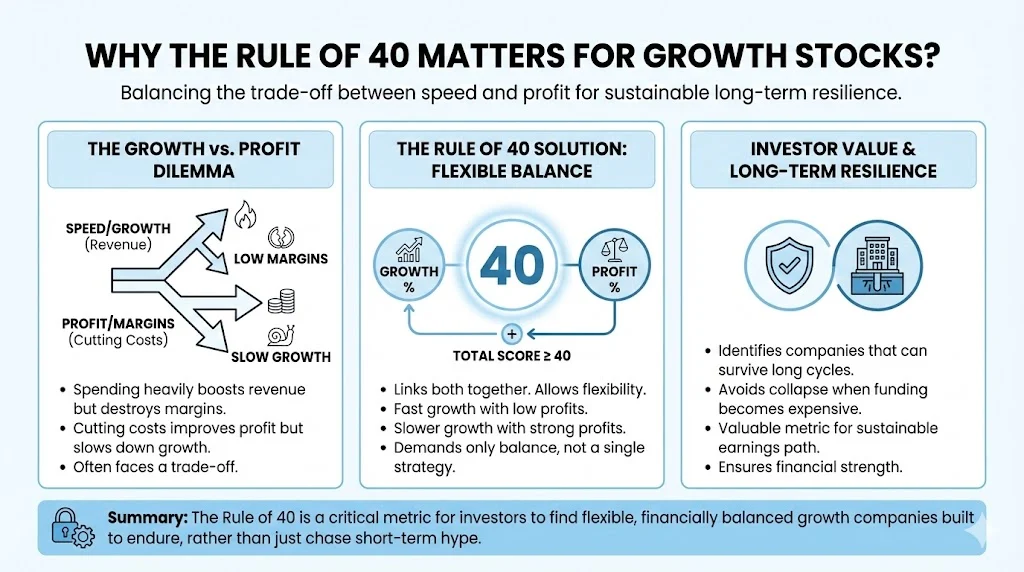
Growth companies often face a trade off between speed and profit. Spending heavily on sales and marketing can increase revenue but destroy margins. Cutting costs can improve profit but slow down growth.
The Rule of 40 solves this problem by linking both together. It allows companies to be flexible. A firm can grow fast with low profits or grow slower with strong profits as long as the total reaches 40.
This makes the rule valuable because it does not force one strategy. It only demands balance. Investors now use this metric to find companies that can survive long cycles and not collapse when funding becomes expensive.
How the Rule of 40 Is Calculated?
The formula is straightforward.
Rule of 40 = Revenue Growth Rate plus Profit Margin
Revenue growth is usually measured using annual recurring revenue or year over year sales growth. Profit margin is commonly measured using EBITDA margin or free cash flow margin.
Example:
Revenue growth = 30 percent
Profit margin = 15 percent
Rule of 40 score = 45
This shows the company meets the benchmark.
A company growing 50 percent can afford a negative margin of minus 10 percent and still reach 40. A company growing only 10 percent must earn at least 30 percent profit margin to qualify.
Also Read: The 100 Minus Age Asset Allocation: Balance Growth and Safety with One Rule
Recent Trends in Rule of 40 Performance
Market data from 2024 to 2026 shows that many public SaaS companies struggle to meet the Rule of 40. Efficiency pressure increased after investors began favoring sustainable earnings over rapid expansion.
The median scores across the sector remain below the benchmark. Only top performers consistently exceed it.
| Year and Period | Median Rule of 40 Score |
|---|---|
| Q4 2024 | Around 15 percent |
| Mid 2025 | About 34 percent |
| Q1 2025 | Around 12 percent |
This data shows that more than half of SaaS companies fall below the target. At the same time, companies that exceed 40 receive strong valuation benefits.
In Q3 2025, every 10 point increase in Rule of 40 was linked with roughly 1.1 times higher valuation multiples. High scoring companies saw valuation premiums rise sharply compared to earlier years.
High Performers and Market Examples
Several technology companies are frequently highlighted for their strong Rule of 40 scores. Firms like Nvidia, Palantir, Snowflake, Microsoft, Google, and Duolingo are often cited as examples of balanced growth and profitability.
Some of these companies have scores above 80 or even above 100. This means they combine very strong revenue growth with healthy margins. These businesses are admired because they show operational discipline along with innovation.
Investors often describe them as quality growth stocks. Their high scores attract attention and support higher share prices.
Why Investors Trust This Rule?
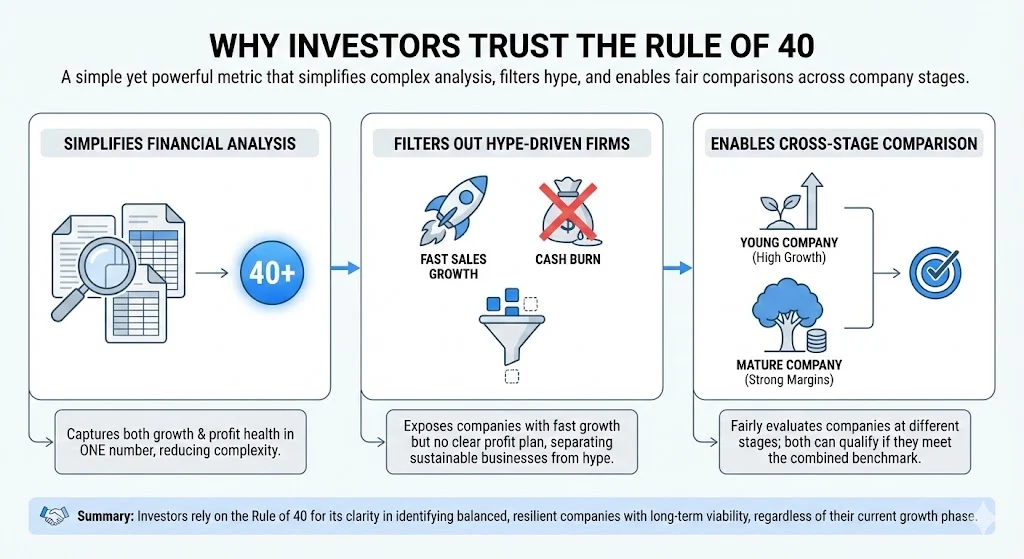
Investors prefer the Rule of 40 because it simplifies complex financial analysis into one number. It captures two critical elements of business health which are growth and profit.
This metric also filters out hype driven companies. Many firms show fast sales growth but burn cash with no clear profit plan. The Rule of 40 exposes this weakness.
It also helps compare companies at different stages. A younger company can score well with growth. A mature company can score well with margins. Both can qualify if they meet the benchmark.
Public Opinion and Market Sentiment (Data From X)
Recent investor discussions show strong admiration for companies that score high on this metric. Many posts celebrate firms that cross 70 or 90 on the scale.
Common reactions focus on quality and discipline. Investors view these companies as safer growth plays in uncertain markets. They believe that balance matters more than speed.
Some criticism exists. A few analysts argue that early stage or AI driven companies should not be judged strictly by this rule. They say innovation sometimes requires heavy spending. However, most market sentiment supports the rule as a long term value indicator.
Limitations of the Rule of 40
The Rule of 40 is not perfect. It does not consider debt levels, customer churn, or market competition. A company can meet the rule for one year but fail later if fundamentals weaken.
It is also less useful for very early stage startups. Young firms may show unstable growth and losses. Their numbers change too quickly for the rule to be meaningful.
The rule should be used with other metrics like customer retention, cash flow stability, and business moat. It works best as a screening tool, not as a final decision maker.
When the Rule of 40 Is Most Useful
The rule is most effective for mid stage and mature SaaS companies. These firms already have revenue history and stable operations. For them, balancing growth and profit becomes essential.
It is also useful during market corrections. When capital becomes expensive, companies that cannot control costs fall quickly. The Rule of 40 helps identify firms that can survive tighter conditions.
For long term investors, it supports disciplined stock selection. It avoids emotional investing in trendy names that lack financial structure.
How the Rule of 40 Protects Investors
Many investors say this rule saves them from buying hyped stocks that burn cash without a clear profit plan. It creates a filter that removes weak business models early.
Companies scoring below 40 often struggle to manage expenses. They face pressure when growth slows. Their valuations drop faster than stronger peers.
By focusing on balance, investors increase the chance of owning firms that can grow through different economic cycles.
Final Thoughts
The Rule of 40 remains one of the most respected tools for analyzing growth companies in 2025 and 2026. It reflects the market’s shift toward efficiency and sustainable value creation.
High scoring companies attract premium valuations because they prove that growth and profitability can coexist. While not perfect, the rule offers a powerful lens to judge business quality.
For investors looking at SaaS and technology stocks, this metric provides clarity in a crowded market. It rewards discipline, filters hype, and highlights firms that are building long term financial strength instead of short term excitement.
Tags: Rule of 40, growth stocks, SaaS investing, financial metrics, stock analysis, business valuation
Related Posts :






Share This Post