The Rule of 114 for Tripling: How Fast Can Your Money 3x?

The Rule of 114 for Tripling How Fast Can Your Money 3x
The Rule of 114 is one of the simplest tools in personal finance for understanding how long it takes for money to triple through compounding.
As more people focus on long term investing in mutual funds and equities, this rule has become popular because it turns complex math into an easy mental shortcut. It helps investors see how time and return rate work together to multiply wealth.
In recent years, the Rule of 114 has gained attention in financial education content across India and global markets. It is often grouped with the Rule of 72 and Rule of 144 as part of essential money rules. Investors use it to plan goals such as retirement, children’s education, and long term wealth creation.
Table of Contents
Key Takeaways
- The Rule of 114 estimates how many years an investment needs to triple in value.
- The formula is simple and works best for long term planning.
- Higher returns reduce the time required to reach financial goals.
- It highlights the power of compounding in a practical way.
- It helps investors avoid unrealistic expectations and emotional decisions.
What Is the Rule of 114?
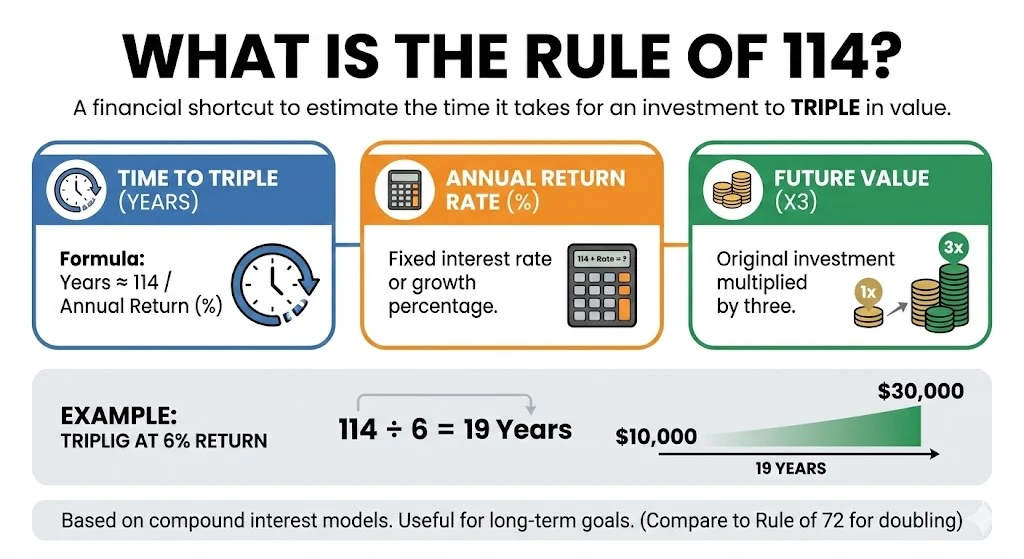
The Rule of 114 is a financial shortcut that shows how long it takes for an investment to grow three times its original value. It assumes that the investment earns a constant annual return and that the gains are compounded over time.
This rule is similar to the well known Rule of 72, which is used to estimate when money will double. The Rule of 114 focuses on tripling instead of doubling. It is useful for long term financial goals where investors want to see how wealth can multiply over decades.
The idea behind this rule comes from mathematical models of compound interest. While the exact formula uses logarithms, the number 114 gives a close estimate for most realistic return ranges between 4 percent and 15 percent.
Also Read: The 40 30 20 10 Rule: A Modern Budget Strategy For Rising Costs
The Formula For Rule Of 114 For Tripling & How It Works
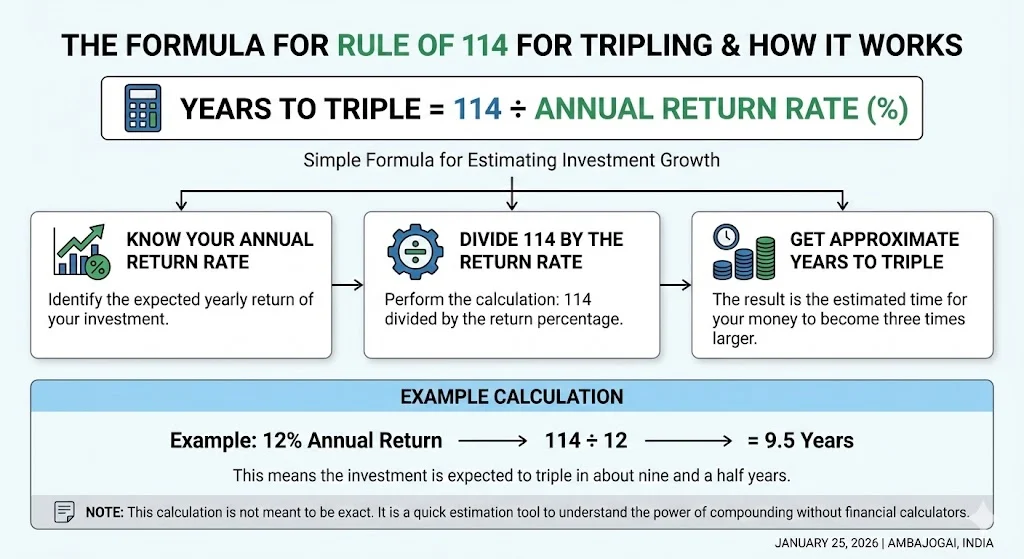
The Rule of 114 uses a very simple formula.
Years to triple = 114 ÷ annual return rate
To apply the rule, an investor only needs to know the expected yearly return of the investment. Dividing 114 by that return gives the approximate number of years required for the money to become three times larger.
For example, if an investment grows at 12 percent per year, dividing 114 by 12 gives 9.5. This means the investment is expected to triple in about nine and a half years.
This calculation is not meant to be exact. It is designed for quick planning and understanding the power of compounding without using financial calculators or spreadsheets.
Why The Rule of 114 Matters In Long Term Planning?
Most people struggle to visualize how small investments grow into large amounts over time. The Rule of 114 makes growth timelines easier to understand. Instead of guessing, investors can see clearly how many years are needed to reach three times their original capital.
This is especially helpful for goals such as retirement savings or education funds. When investors know how long tripling takes, they can decide how much risk to take and how early they need to start.
The rule also encourages patience. It shows that wealth creation is not instant. It is the result of steady returns and long holding periods.
Examples of the Rule of 114 in Action
The Rule of 114 becomes clearer when applied to different return rates. The table below shows how long it takes for money to triple at common rates of return.
| Annual Return Rate | Years to Triple (114 ÷ Rate) |
|---|---|
| 6 percent | 19 years |
| 8 percent | 14.25 years |
| 10 percent | 11.4 years |
| 12 percent | 9.5 years |
| 15 percent | 7.6 years |
These numbers explain why higher returns have such a powerful effect on long term wealth. At 6 percent, it takes almost two decades to triple money. At 15 percent, the same result can be achieved in less than eight years.
This simple table helps investors compare scenarios and choose strategies that match their financial goals and risk tolerance.
Relationship With Other Investment Rules
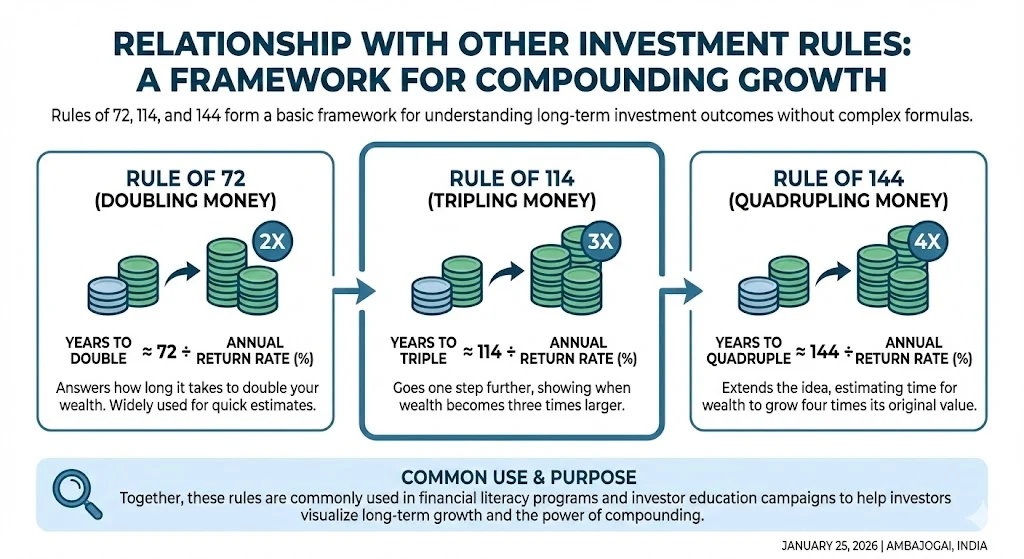
The Rule of 114 is often taught alongside other compounding rules. These include:
- Rule of 72 for doubling money
- Rule of 114 for tripling money
- Rule of 144 for quadrupling money
Together, these rules form a basic framework for understanding investment growth. They are commonly used in financial literacy programs and investor education campaigns.
The Rule of 72 answers how long it takes to double wealth. The Rule of 114 goes one step further by showing when wealth becomes three times larger. The Rule of 144 extends the idea to four times growth. These rules help investors visualize long term outcomes without complex formulas.
Popularity Among Retail Investors (Data Taken From X)
The Rule of 114 has become popular in recent years due to increased interest in mutual funds, SIPs, and equity investing. Many investors use it to project aggressive growth scenarios such as turning one lakh into three lakh or building crores over several decades.
It is widely shared in educational posts and finance discussions because of its simplicity. People often describe it as an eye opening rule that shows how compounding works better than saving alone.
The rule is also common in personal finance content written in both English and Hindi. This has helped spread awareness among first time investors and young professionals.
Psychological Value of the Rule
Beyond math, the Rule of 114 has strong psychological value. It motivates people to start early and stay invested. When investors see that their money can triple in a fixed time frame, they feel more confident about long term plans.
It also prevents emotional decisions. During market ups and downs, investors can remember that compounding needs time. Short term losses look smaller when viewed against long term tripling goals.
This discipline is one of the biggest benefits of using such rules. It replaces fear and excitement with structure and clarity.
Limitations of the Rule of 114
The Rule of 114 is a simplified estimate. It assumes a constant annual return, which rarely happens in real markets. Returns change from year to year based on market conditions.
It also does not consider inflation, taxes, or investment fees. These factors reduce actual returns and can increase the time needed to triple money.
The rule works best for moderate return ranges such as 6 to 15 percent. At very low or very high rates, accuracy decreases. It should be used as a planning guide rather than an exact prediction.
Practical Uses in Real Life
The Rule of 114 can be used for many personal finance decisions.
Investors use it to plan retirement timelines. Parents use it to estimate how education funds may grow. Young professionals use it to compare different investment strategies.
It is also useful in understanding inflation. Similar logic can show how purchasing power declines over time when inflation compounds.
Because of its simplicity, the rule is often included in lists of essential money principles alongside budgeting rules and emergency fund guidelines.
The Power of Compounding Explained Simply
Compounding means earning returns on both the original investment and the accumulated gains. Over time, this creates exponential growth.
The Rule of 114 makes this effect visible. It shows that tripling money does not depend only on saving more. It depends on staying invested long enough for compounding to work.
This is why early investing matters. The earlier the investment begins, the more cycles of tripling can occur over a lifetime.
Final Thoughts
The Rule of 114 is a practical and easy to remember tool for understanding how long it takes to triple money through compounding. It simplifies financial planning and helps investors see the real value of time and consistent returns.
It does not replace detailed financial analysis, but it offers a clear picture of growth potential. By using this rule, investors can set realistic expectations, plan long term goals, and stay focused during market fluctuations.
In a world where financial decisions often feel complex, the Rule of 114 stands out as a simple guide that turns abstract growth into a clear timeline. It continues to inspire investors to trust the process of compounding and build wealth with patience and discipline.
Tags: Rule of 114, compounding, personal finance, investment planning, wealth growth, money rules
Related Posts :





Share This Post