Waaree Energies Share Is Falling: 126% US Tariff Shock Or Market Overreaction?
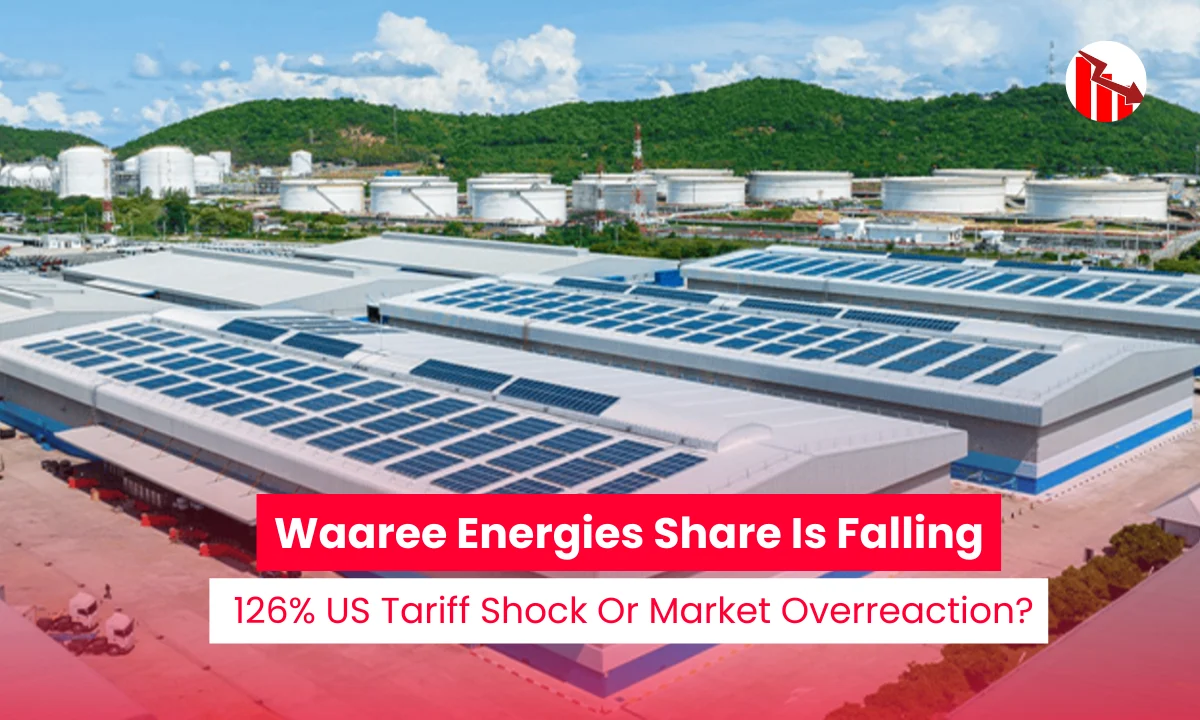
Waaree Energies Share Is Falling 126% US Tariff Shock Or Market Overreaction | Image Via © Livemint.com
Waaree Energies share price is falling sharply after the US president Donald Trump announced a massive 126% countervailing duty on solar imports from India and some other counties.
After the sudden announcement Investors saw solar stocks turn red today and started panic selling across solar stocks. If you are searching for why Waaree Energies share is falling today?
The answer is not just about one tariff headline but also about export exposure, earnings visibility and pure market sentiment.
The stock fell from 14 – 15% intraday after the announcement. But later there was partial recovery after clarification by the management.
So what is really happening in the solar secor?. Is this a structural problem or just short term volatility due to Donald Trump. Let us break it down properly in this blog post.
Key Takeaways
- US imposed 125.87% preliminary countervailing duty on Indian solar imports
- Waaree earns around 29 to 32.6% revenue from overseas markets mainly US
- Stock fell nearly 15% intraday before partial recovery
- Company says duty not applicable to certain modules due to supply chain structure
- 1.6 GW US manufacturing plant acts as buffer
- Sector wide panic but impact varies company to company
- Domestic solar demand in India remains strong
What Triggered The Fall In Waaree Energies Share?
The main trigger was the US Commerce Department decision to impose 125.87 percent preliminary countervailing duties on solar cells and modules imported from India. The US claims Indian manufacturers receive government subsidies which distort pricing.
For a company like Waaree Energies this is serious because the US is one of the largest solar markets globally. Around 29 to 32.6 percent of its recent quarterly revenue comes from overseas markets.
When a 126 percent duty is imposed, Indian exports automatically become expensive in the US. That means lower competitiveness, potential order cancellations and pressure on margins. Markets hate uncertainty. So traders did not wait. Selling started immediately.
How The Market Reacted On February 25, 2026
Here is how the numbers played out.
| Particulars | Data |
|---|---|
| Previous Close | Around ₹3,023 to ₹3,025 |
| Intraday Low | Around ₹2,570 to ₹2,580 |
| Intraday Fall | 14% to 15% |
| Current Trading Range | ₹2,680 to ₹2,710 |
| Revenue From Overseas | 29% to 32.6% |
The stock even hit lower circuit early in the session before recovering partially after company clarification.
Other solar stocks like Premier Energies and Vikram Solar also fell. But Waaree saw sharper pressure because its export exposure is higher.
Company Level Exposure Comparison
Let us compare exposure properly because this is where the real difference lies.
Waaree Energies
- Overseas revenue contribution around 32.6%
- US is key export destination
- 22.8 GW module manufacturing capacity in India
- 1.6 GW manufacturing facility in Texas USA
- Plans to expand US capacity to 2.6 GW by FY27
- Order book around ₹60,000 crore
High export exposure means high sensitivity to US trade policy.
Premier Energies
- Less than 1% revenue from exports
- Primarily domestic focused
- Direct tariff impact minimal
Stock fell mainly due to sector sentiment.
Vikram Solar
- Around 20% order book linked to exports
- Moderate exposure
- Risk manageable compared to Waaree
So clearly the impact is not equal across the sector.
Important Twist: Management Clarification
After the sharp fall, Waaree management clarified that the 126 percent duty applies to modules using India based cells that fall under certain sourcing criteria. According to management, their current supply chain structure means the duty is not applicable to them at this moment.
They also mentioned that their order book is protected and sourcing is diversified. This statement helped the stock recover from day lows. But market participants are still cautious because this is a preliminary duty. Final rulings are pending.
Public Opinion On X Platform
Public sentiment on X platform is largely panic driven. Many users described it as a crash and shock. Common reactions included:
- 15% crash and 126% US duty shock
- Solar stocks crash on US tariff
- Makes it tricky to invest in businesses dependent on US
- Trump trade policy creating dark times for investors
Some informed users also posted breakdowns like:
Waaree 29% export exposure most vulnerable but has US plant as buffer
Premier minimal exposure safer
Few users highlighted positive angle that India still has strong domestic protection like Basic Customs Duty and ALMM norms which block Chinese imports. Overall mood is cautious and slightly negative. But not completely hopeless.
Does The US Plant Change The Game
This is the most important question.
Waaree has a 1.6 GW module manufacturing facility in Texas. It plans to expand to 2.6 GW by FY27. Local production in the US means it can bypass import duties for part of demand. However majority of its capacity is still based in India. So US facility is a cushion not a complete shield.
If US demand continues strong and local capacity scales up fast, impact can be controlled. But if exports from India slow significantly then near term earnings could see pressure.
Broader Industry Context
India’s renewable energy push is still strong. Government backed PLI schemes support domestic manufacturing. High import duties on Chinese modules protect local players.
Domestic solar installations are rising steadily. So home market fundamentals are intact. The problem right now is export uncertainty.
Also remember this is preliminary countervailing duty. Next step could include anti dumping investigations. So policy risk premium increases for export heavy companies.
Is This Panic Or Fundamental Damage
There are two sides to this.
On one side:
- 32% overseas revenue is meaningful
- 126% duty sounds scary
- Earnings visibility reduces
- Valuation may compress
On the other side:
- US plant provides buffer
- Management says current modules not impacted
- Strong domestic demand
- Large order book of ₹60,000 crore
So the truth is somewhere in between. Short term volatility is expected. Long term impact depends on final duty outcome and company execution.
What Investors Should Track Next
Instead of reacting emotionally, track these factors:
- Final decision on US countervailing duty
- Any anti dumping duty announcement
- Capacity ramp up in US plant
- Order book conversion speed
- Margin guidance in next earnings call
- Export revenue mix changes
These data points will decide whether this fall was justified or exaggerated.
Why Waaree Energies Share Is Falling In One Line
Waaree Energies share is falling mainly due to US imposing 126% preliminary tariff on Indian solar imports, creating fear of export slowdown and margin pressure, especially because around one third of its revenue comes from overseas markets. But company clarification and US manufacturing presence reduce some of that fear.
Final Thoughts On Why Waaree Energies Share Is Falling?
This event shows one simple lesson. When a company depends heavily on a specific geography, policy risk becomes real. Solar sector globally is linked with subsidies, tariffs and trade wars. So volatility is part of the game.
Waaree Energies is fundamentally strong in domestic market. It has global ambitions. But right now US trade policy has created uncertainty.
Whether this becomes a long term earnings issue or just a short term sentiment shock will depend on upcoming developments. For now market is reacting to risk. And risk always gets priced quickly
Related Posts :





Share This Post