Accenture AI Strategy 2026: Promotions Linked To AI Usage And The Big Agentic Bet
Accenture AI Strategy 2026 Promotions Linked To AI Usage And The Big Agentic Bet
Accenture AI is not just another consulting buzzword in 2026. It has become a full scale cultural shift inside the company. From AI Refinery to agentic AI systems, from training 550,000 employees to tracking weekly logins for promotions, Accenture is going all in. If you are searching for Accenture AI promotions or Accenture agentic AI strategy, you are probably trying to understand one thing. Is this bold leadership or too much pressure on employees?
The interesting part is that this is not just about tools. It is about power, autonomy, and trust in enterprise AI. With strong executive backing and massive investment, Accenture is trying to position itself as the reinvention partner of choice in the AI era. But as always, the real story is a mix of ambition and internal resistance.
Key Takeaways
- Accenture is linking leadership promotions to regular AI tool adoption
- Weekly AI tool logins are being tracked for senior managers and associate directors
- Over 550,000 employees have been trained in generative AI
- Accenture now has 80,000 AI and data professionals globally
- AI Refinery is central to scaling enterprise AI agents
- 86% of executives plan to increase AI investments in 2026
- Public opinion on X shows admiration and tension around the policy
- Agentic AI and autonomy are core themes of Accenture Technology Vision
Why Accenture AI Is More Than Just A Promotion Policy
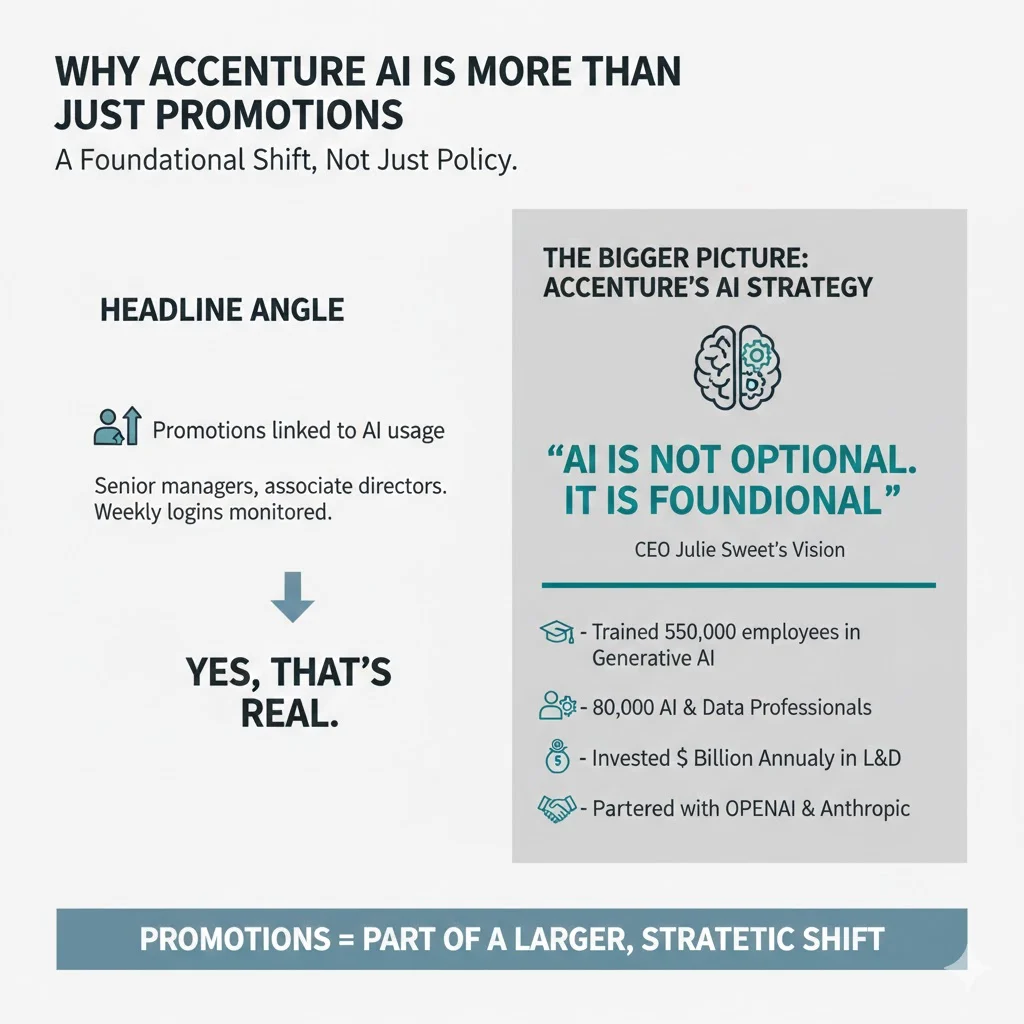
Most headlines focus on one angle. Promotions linked to AI usage. Yes, that part is real. Senior managers and associate directors are expected to show regular adoption of internal AI tools. Weekly logins are reportedly visible in talent discussions. But if we zoom out, the bigger picture looks different.
Under CEO Julie Sweet, Accenture has clearly declared that AI is not optional. It is foundational. Her earlier statement about exiting employees who cannot reskill around AI created strong reactions. Now HR policies are aligning with that message.
This move did not happen in isolation. Accenture has:
- Trained 550,000 employees in generative AI
- Built a workforce of 80,000 AI and data professionals
- Invested around $1 billion annually in learning and development
- Partnered with OpenAI and Anthropic
So when they say AI adoption matters for promotions, it fits into a much larger enterprise transformation strategy.
Also Read: Gaudium IVF IPO GMP Today: 11% Listing Gain Or Cooling Hype? Full Breakdown For Investors
The Role Of Accenture AI Refinery In Enterprise Scaling
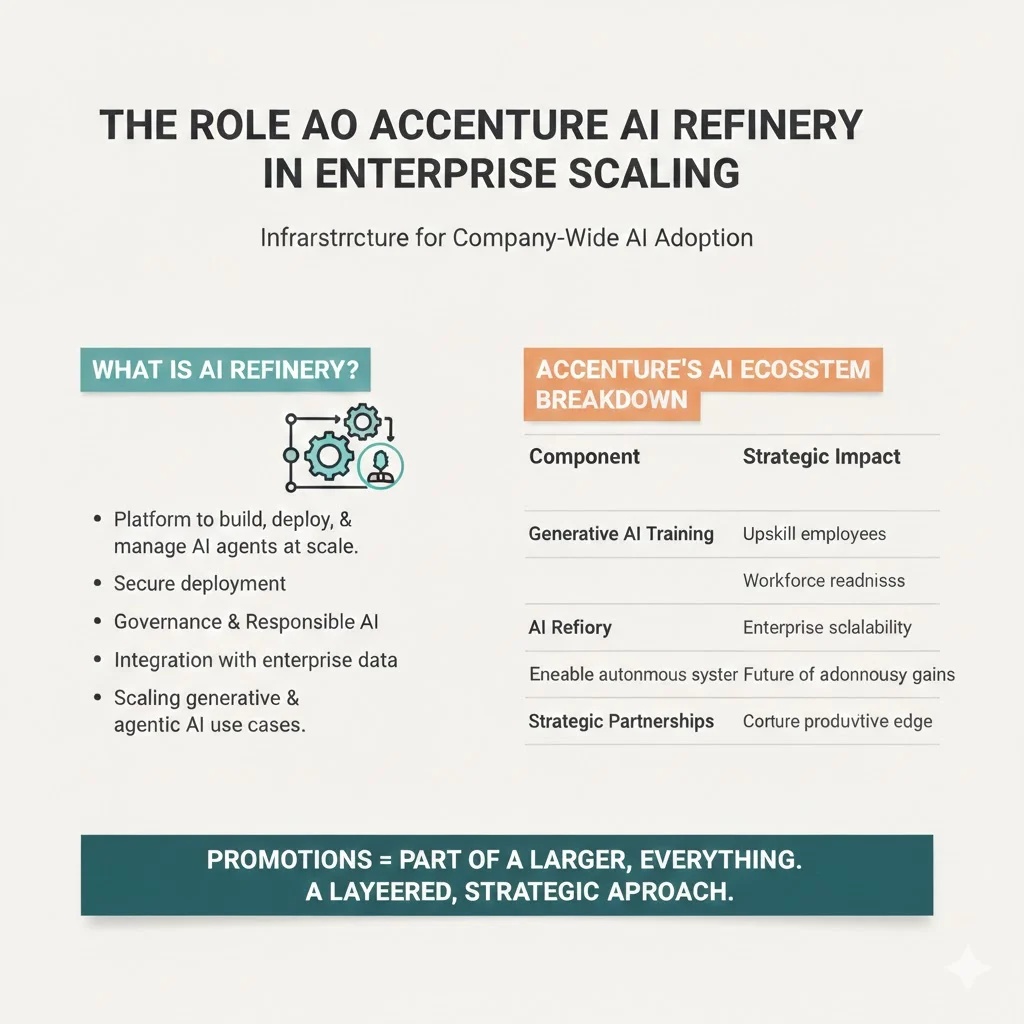
One term that keeps popping up in searches is AI Refinery. This is not just a random tool. It is positioned as a platform to build, deploy, and manage AI agents at scale.
AI Refinery focuses on:
- Secure deployment of AI agents
- Governance and responsible AI frameworks
- Integration with enterprise data systems
- Scaling generative and agentic AI use cases
Instead of offering isolated AI experiments, Accenture is building infrastructure for enterprise wide adoption. This is important because many companies struggle with moving from pilot projects to real scale.
Here is a simple breakdown of Accenture’s AI ecosystem:
| Component | Purpose | Strategic Impact |
|---|---|---|
| Generative AI Training | Upskill employees | Workforce readiness |
| AI Refinery | Deploy AI agents securely | Enterprise scalability |
| Agentic AI Frameworks | Enable autonomous systems | Future productivity gains |
| Strategic Partnerships | Access to advanced models | Competitive edge |
This layered approach explains why Accenture stopped breaking out specific AI booking metrics after Q1 FY2026. AI is now embedded into nearly everything they sell.
The Big Bet On Agentic AI And Autonomy
Another major theme is agentic AI. According to Accenture Technology Vision 2025, we are entering a new age of AI defined by autonomy.
Some key insights from leadership surveys:
- 77% believe AI agents will reinvent digital system building
- 78% say digital ecosystems must be designed for both humans and AI agents
- 86% of C suite leaders plan to increase AI investments
- 78% now see AI as more beneficial for revenue growth than cost reduction
This shift is interesting. Earlier, AI was sold as a cost cutting tool. Now it is positioned as a revenue and growth driver. That narrative change matters for clients and investors.
Agentic AI refers to systems that can act with higher levels of independence. Not just responding to prompts but executing multi step workflows. For consulting, this means:
- Automated research synthesis
- Proposal generation
- Risk analysis
- Client reporting
- Internal knowledge management
Basically, AI moves from assistant to collaborator.
Public Opinion On X: Admiration And Anxiety
If you check conversations on X around Accenture AI promotions, you will notice mixed reactions.
What People Admire
- Massive training of 550,000 employees
- Bold leadership stance on AI adoption
- Clear enterprise scale implementation
- Focus on responsible AI and trust
- India focused AI summits and events
Many posts call it a smart move. The logic is simple. If Accenture advises clients on AI transformation, its own leaders must walk the talk.
Where The Tension Lies
- Some senior staff reportedly call tools ineffective
- Older professionals feel pressured
- Humor around flooded LinkedIn profiles with AI certificates
- International headlines framing it as no AI no promotion
There is also a generational gap. Surveys globally show older workers are less confident about AI adoption. At the same time, junior staff adapt faster. This creates internal cultural friction.
But from a business standpoint, Accenture seems to be choosing speed over comfort.
Financial Context And Strategic Pressure
Another angle competitors mentioned but did not deeply explore is the business pressure. Accenture’s share price has reportedly declined significantly over the past year. Revenue growth remains modest. In such a scenario, doubling down on AI becomes a strategic necessity.
AI driven reinvention is not just branding. It is survival strategy in a consulting market where clients demand measurable productivity gains.
Leading adopters of AI reportedly see productivity improvements of up to 20%. If Accenture can demonstrate that internally, it strengthens its client pitch.
Is This The Future Of Corporate Promotions
The biggest question readers are asking is simple. Will other firms copy this model? Big Four firms and global consultancies are already pushing AI adoption. But linking promotions directly to usage metrics is aggressive.
This approach has three implications:
- AI literacy becomes a core leadership skill
- Cultural resistance is directly challenged
- Internal data tracking becomes normalized
It also raises broader workplace questions. If AI fluency becomes mandatory, how should companies support employees? Training, context, and practical use cases become critical.
Accenture’s heavy investment in training shows they are not just forcing adoption. They are trying to build capability at scale.
The India Angle And Global Positioning
In India, Accenture has a massive workforce footprint. AI focused summits, training initiatives, and digital transformation projects are getting positive coverage.
For many Indian professionals, this is seen as opportunity. AI skill building increases global competitiveness. Certifications and internal adoption could enhance long term career prospects. At the same time, the message is clear. Future leaders must be comfortable working with AI systems.
What Makes Accenture Different From Competitors
Many consulting firms talk about AI. Accenture is embedding it into:
- Promotion criteria
- Internal KPIs
- Workforce identity
- Service offerings
- Platform architecture
This deep internal integration differentiates it from firms that treat AI as an add on service line. Their positioning as a reinvention partner aligns with their structural changes. Merging divisions into reinvention services and calling employees reinventors is symbolic but strategic.
Final Thoughts On Accenture AI In 2026
Accenture AI in 2026 is about autonomy, accountability, and acceleration. The promotion policy grabbed headlines. But the real story is enterprise wide embedding of generative and agentic AI.
Some employees feel the heat. Some admire the clarity. Investors are watching the growth narrative. Clients are watching execution.
One thing is clear. Accenture is not treating AI as optional training material. It is making it a career defining capability.
And honestly, in today’s market, that move looks less like a threat and more like a signal of where the corporate world is heading.
Related Posts :





Share This Post